Underground Oil Tank Removal in Philadelphia
A buried tank is the version of this job with real consequences attached, because everything that matters happens out of sight until the ground is open. Until someone digs, nobody knows whether the shell is intact, how much product is still in it, or what the soil underneath has been absorbing.
The sequence below is what a removal in Philadelphia actually looks like, including the parts that are specific to a city of narrow lots and shared walls.
Finding The Tank Before Booking The Work
Most Philadelphia homeowners find out they have a tank from a fill pipe or a vent stub against an exterior wall, a capped line in a basement, or a buyer's inspector pointing at one. Those are indicators, not confirmation. The pipe can be a remnant of a tank that was pulled decades ago, and a tank can exist with every visible trace paved over.
Where the position is uncertain, locating comes first. That is a separate exercise from removal and is covered on the tank sweep page. Booking an excavation around a guess is how a yard gets opened in the wrong place.
Access In A City Of Narrow Lots
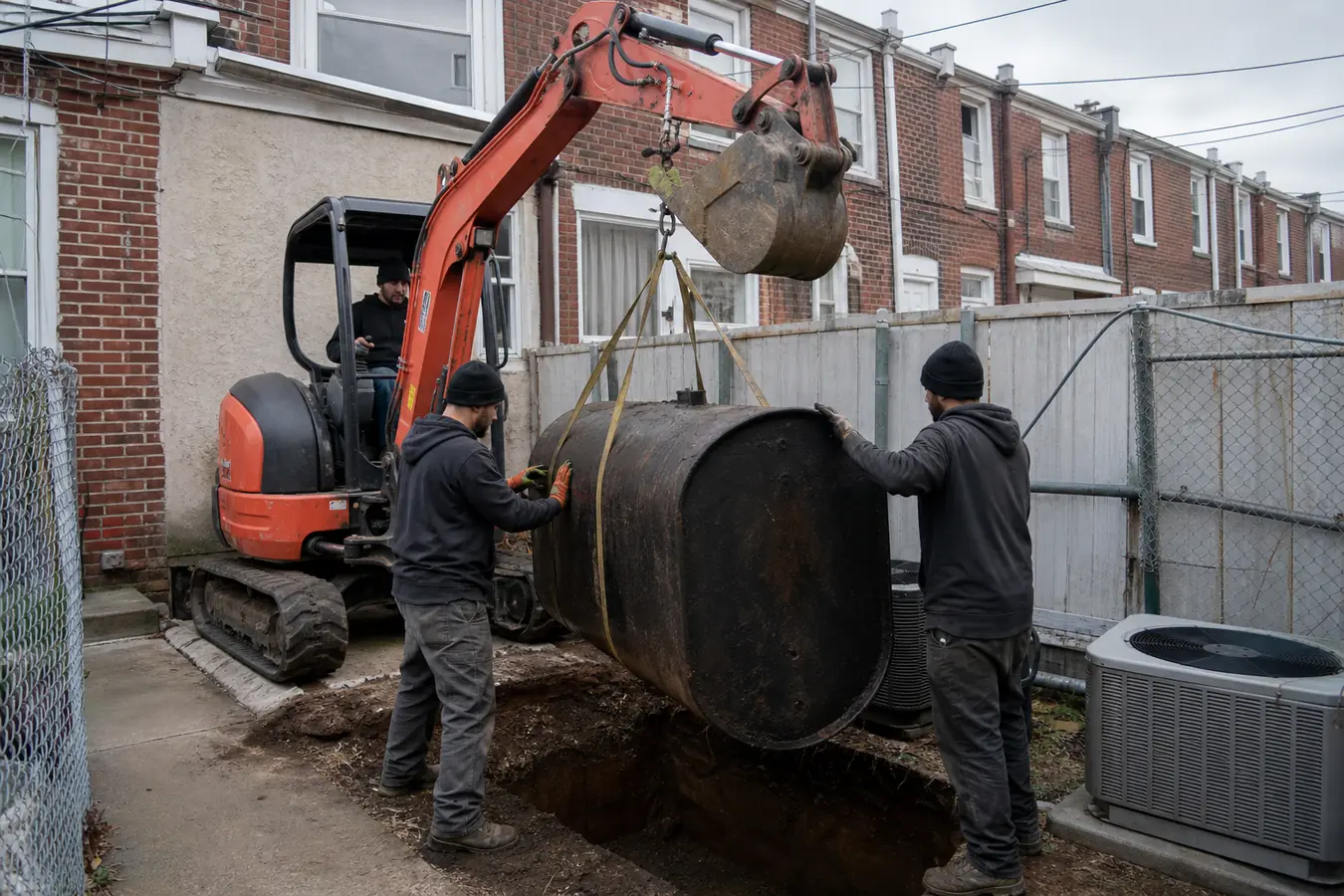
Access decides the method more often than the tank does. A detached property in Chestnut Hill with a driveway takes a mini excavator straight to the tank. A rowhouse in Mayfair or Port Richmond with a 14 foot rear yard reached only through the house or a shared alley is a different job, sometimes a hand-dig, and the difference is measured in days rather than hours.
What sits above the tank matters just as much. A tank under a concrete pad, a patio, a driveway apron or mature planting means the surface has to come up and then be put back, and the reinstatement is often the part a homeowner cares most about. The City wants that answered up front: the permit plans have to show surface restoration details for an underground tank.
Party walls and neighboring structures set the last constraint. Excavating hard against a shared wall needs the working space planned before anyone arrives, not negotiated on the day with a machine already on the street.
City of Philadelphia L&I, hazardous material tank permit (checked Aug 2026)
The Call That Has To Happen Before Anyone Digs
Pennsylvania One Call is not optional and it is not a formality. Under Act 287 of 1974 as amended, notification has to go in a minimum of three business days, but not more than ten business days, before excavation starts, and the requirement is triggered by using powered equipment in the movement of earth, rock or other material.
It applies to the person doing the digging. PA One Call's own guidance puts the duty on a homeowner excavating their own residential property and on an excavator hired by a homeowner to work on it, so hiring a contractor does not make the notice somebody else's problem in the abstract. On a job we run, the notice is ours.
The practical effect is on your calendar rather than your bill. Three business days is the floor, so a removal cannot be booked for tomorrow, and that matters when the work is tied to a settlement date. It is the most common reason a job that everyone agreed on quickly still starts next week.
PA One Call, Act 287 of 1974 as amended (checked Aug 2026)
Emptying, Cleaning And Lifting
Remaining product is pumped out first, then the tank is cleaned of the sludge that settles over decades. The petroleum is manifested and disposed of in line with Pennsylvania DEP requirements. Anyone quoting a removal without asking what is still in the tank is quoting for a job they have not scoped.
The tank is then excavated and lifted whole where the space allows it. Where it does not, and in tight rear yards it often does not, the tank is cut and brought out in sections after it has been cleaned and made safe. Both are normal. What is not normal is a tank being cut before it has been emptied and cleaned.
PA DEP underground storage tanks program (checked Aug 2026)
Sampling While The Hole Is Open
Soil samples are taken from beneath and around the tank while the excavation is still open, because that is the only moment they can be taken without digging twice. This is the step that converts a removal into a closed question.
A clean laboratory result is the document that answers a buyer, a lender, an insurer or a title company for good. It is worth more than the removal itself in any transaction. A result showing contamination starts a different process, set out on the remediation page, and it also starts a clock: under 25 Pa. Code section 245.305 a confirmed release has to be reported to the appropriate DEP regional office as soon as practicable and no later than 24 hours after confirmation.
25 Pa. Code section 245.305, reporting releases (checked Aug 2026)
Backfill, Restoration And The Record
The excavation is backfilled with clean material and compacted, and the surface is put back to whatever was agreed at survey. Getting that agreement in writing beforehand is the difference between a finished job and an argument, particularly where a driveway or a patio has been cut.
At the end you should hold three things: the City permit and its Certificate of Approval, the laboratory result for the soil samples, and the disposal documentation for the tank and its contents. That set is what a future buyer's attorney asks for. A removal without it is a removal you cannot prove.
City of Philadelphia L&I, hazardous material tank permit (checked Aug 2026)
Related
- Basement and Above-Ground TanksCut down and carried out of a rowhouse without opening the ground
- Abandonment In PlaceWhen filling is allowed, and what a lender does with it afterwards
- What It CostsEvery line that moves the number, and the ones nobody quotes for
- Soil RemediationWhat happens when the ground under the tank turns out to be dirty
Common Questions
- How deep are Philadelphia heating oil tanks usually buried?
- There is no single depth. Residential tanks were installed to suit the property, so a tank can sit close to the surface under a yard or well down under a driveway. Depth is established at survey rather than assumed, because it changes the machine, the time on site and the reinstatement.
- Will you have to dig up my driveway or patio?
- If the tank is under it, yes. The permit plans have to show surface restoration details for an underground tank, so what gets cut and how it gets put back is agreed before the work is approved rather than discovered afterward.
- What if the tank turns out to be leaking?
- The job stops being a removal and becomes a cleanup. Contaminated soil is excavated, further samples establish the extent, and a confirmed release is reported to the DEP regional office no later than 24 hours after it is confirmed. Costs above a $1,000 deductible may be reimbursable up to $4,000 for tanks of 3,000 gallons or less.
- How far ahead does the work have to be booked?
- At least three business days, because Pennsylvania One Call notification has to be placed a minimum of three and no more than ten business days before excavation begins under Act 287. That is a floor set by statute rather than by scheduling, so it is worth knowing if the removal is tied to a settlement date.
- Can I remove a buried oil tank myself?
- Not in Philadelphia. The City requires a building permit to remove a hazardous material tank and requires the work to be done by a licensed contractor with current insurance on file with L&I, and a DEP Company Certification where the tank is DEP regulated.
A Written Quote For Your Property
You do not need technical details. The address and where you think the tank sits are enough to start a useful conversation about access, permits and the likely method.
Where This Came From
Every fee, rule and figure on this page came from one of the following, each checked on the date shown. Full citations and links are on the sources page.
- City of Philadelphia, Get a building permit for a tank to store hazardous materials (checked Aug 2026)
- Pennsylvania One Call System, Excavator FAQs (Act 287 of 1974 as amended, 73 P.S. section 176 et seq.) (checked Aug 2026)
- Pennsylvania Department of Environmental Protection, Underground Storage Tanks (checked Aug 2026)
- 25 Pa. Code Chapter 245, section 245.305 (Reporting releases) (checked Aug 2026)