Buying A Philadelphia House With An Oil Tank
This is how most people arrive at the subject. An inspector points at a fill pipe on the side of a rowhouse, or a sweep turns something up in the rear yard, and a straightforward purchase acquires a question nobody in the transaction wants to own.
The question is answerable, and it is much cheaper to answer before closing than after. What follows is the order to take it in.
Establish What Is Actually There
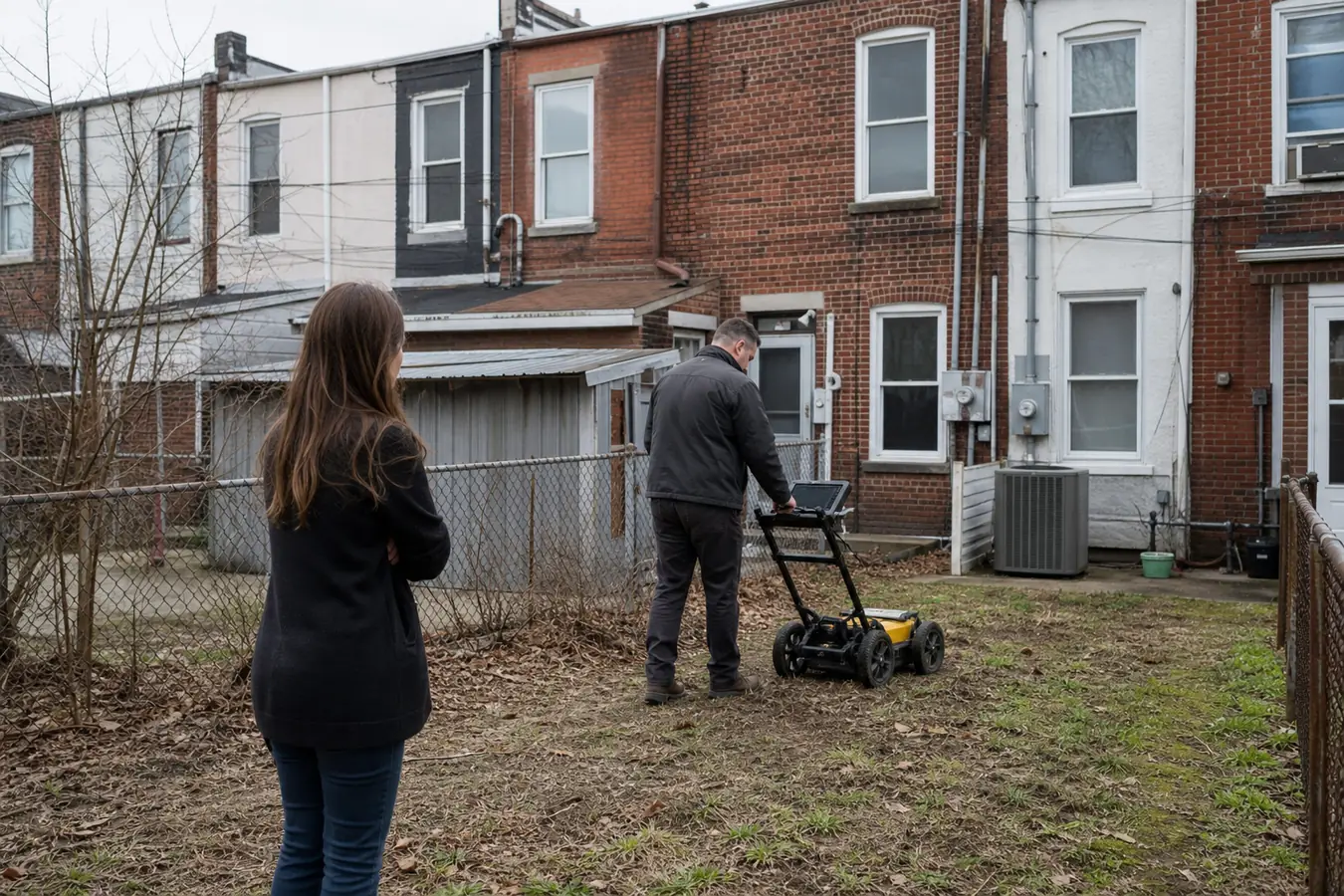
A fill pipe is evidence, not proof. Lines are routinely left in place when a tank is pulled, because removing them means opening a wall. The first step is to establish whether a tank exists, where it is, and whether it is still in use, which is what an oil tank sweep is for.
Ask the seller directly and in writing what they know. A seller who removed a tank properly has a permit and a Certificate of Approval and will be glad to produce them. A seller who has no paperwork is telling you something either way.
The Question That Matters Is The Soil
Whether the tank is still in the ground is a cost question. Whether it leaked is a liability question, and it is the one that follows the property rather than the transaction.
That means soil sampling is the item to insist on, not just tank removal. A tank taken out during the inspection window with no samples taken leaves you owning a hole in the ground and no evidence about what was under it. Samples taken while the excavation is open cost a fraction of reopening it later.
Timing It Against Your Inspection Window
Everything above belongs inside the inspection period, because that is the window in which a finding can still change the price or the deal. The same finding after closing is simply yours.
Work backwards from your dates. A sweep is quick. A removal needs a City permit filed by a licensed contractor, and soil results come back from a laboratory rather than on the day. If the calendar does not fit, the realistic options are an extension, an escrow holdback, or a price adjustment that reflects a job you will be commissioning yourself.
City of Philadelphia L&I, hazardous material tank permit (checked Aug 2026)
Who Pays, And What To Ask For
There is no rule, only negotiation, and it turns on the market and on how much either side wants the deal. What matters more than who pays is what gets delivered.
If the seller is handling it, ask for the Certificate of Approval, the soil sampling results and the disposal documentation as a condition, rather than for confirmation that the work was done. Work without those documents is work you cannot demonstrate to your own buyer in eight years.
If it is being handled through a credit, price it against the cost drivers rather than against a number someone recalls hearing, and account for the possibility of contamination rather than assuming the clean case.
Tanks Already Abandoned In Place
You will meet properties where a tank was filled with sand in the 1980s or 1990s and nothing was written down. Treat that as an unknown rather than as a resolved item, because that is how your lender, your insurer and your own future buyer will treat it.
The abandonment page covers what a defensible fill looks like and what to do about one that has no record. Note that some lenders and insurers decline properties with a tank abandoned in place even where documentation is complete, so it is worth establishing your lender's position early rather than in the last week.
Related
- Selling A House With A TankWhat the disclosure form asks, and the two year window after settlement
- Oil Tank SweepFinding out whether anything is buried, and what a sweep cannot prove
- Abandonment In PlaceWhen filling is allowed, and what a lender does with it afterwards
- What It CostsEvery line that moves the number, and the ones nobody quotes for
Common Questions
- Should I walk away from a house with a buried oil tank?
- Rarely, on that fact alone. It is a solvable and quantifiable problem in a city where a large share of the pre-1970 housing stock has one. What makes it a reason to walk is a seller unwilling to let it be investigated inside the inspection window.
- Can I make tank removal a condition of sale?
- You can ask for it, and it is common. The stronger version is to make delivery of the documentation the condition, meaning the City Certificate of Approval, the soil sampling results and the disposal records, rather than just the physical removal.
- What if the seller says the tank was removed years ago?
- Ask for the permit and the Certificate of Approval. Philadelphia has required a permit to remove a hazardous material tank, so a properly handled removal generates a record. No record does not prove the tank is still there, but it does mean nobody can show it is not.
- Will a buried tank stop my mortgage?
- It can, and policies differ between lenders. Some decline on a tank in the ground, some on a tank abandoned in place, and some are satisfied by documented removal with clean soil results. Establish your lender's position before you build a timeline around it.
A Written Quote For Your Property
You do not need technical details. The address and where you think the tank sits are enough to start a useful conversation about access, permits and the likely method.
Where This Came From
Every fee, rule and figure on this page came from one of the following, each checked on the date shown. Full citations and links are on the sources page.
- City of Philadelphia, Get a building permit for a tank to store hazardous materials (checked Aug 2026)