Oil Tank Removal Cost in Philadelphia
Every published price for oil tank removal is a range, and the ranges disagree with each other by a factor of five. That is not because anyone is lying. It is because the four things that set the price are all unknown until someone looks at the property.
This page does two things instead of quoting a range we cannot stand behind. It lists the costs that are fixed and published, and it sets out exactly which variables move the rest, so you can read a quote and tell whether it has been thought about.
The Fees That Are Fixed And Published
The City of Philadelphia charges $158 per tank for the permit, plus a filing fee of $25 for a one or two family dwelling or $100 for other sites, a $3 City surcharge and a $4.50 State surcharge per permit. Those are published figures, they are the same for everyone, and they should appear on your quote as a pass-through rather than disappearing into a round number.
Two tanks means two permit fees. A property with a buried tank and a disused basement tank is two permits, not one.
Going the other way, if the tank has leaked, up to $4,000 of eligible cleanup costs above a $1,000 deductible may be reimbursable through the Pennsylvania DEP program for tanks of 3,000 gallons or less. That is money back rather than money out, and it is set out on the reimbursement page.
City of Philadelphia L&I, hazardous material tank permit (checked Aug 2026)PA DEP heating oil tank cleanup reimbursement (checked Aug 2026)
What Actually Moves The Number
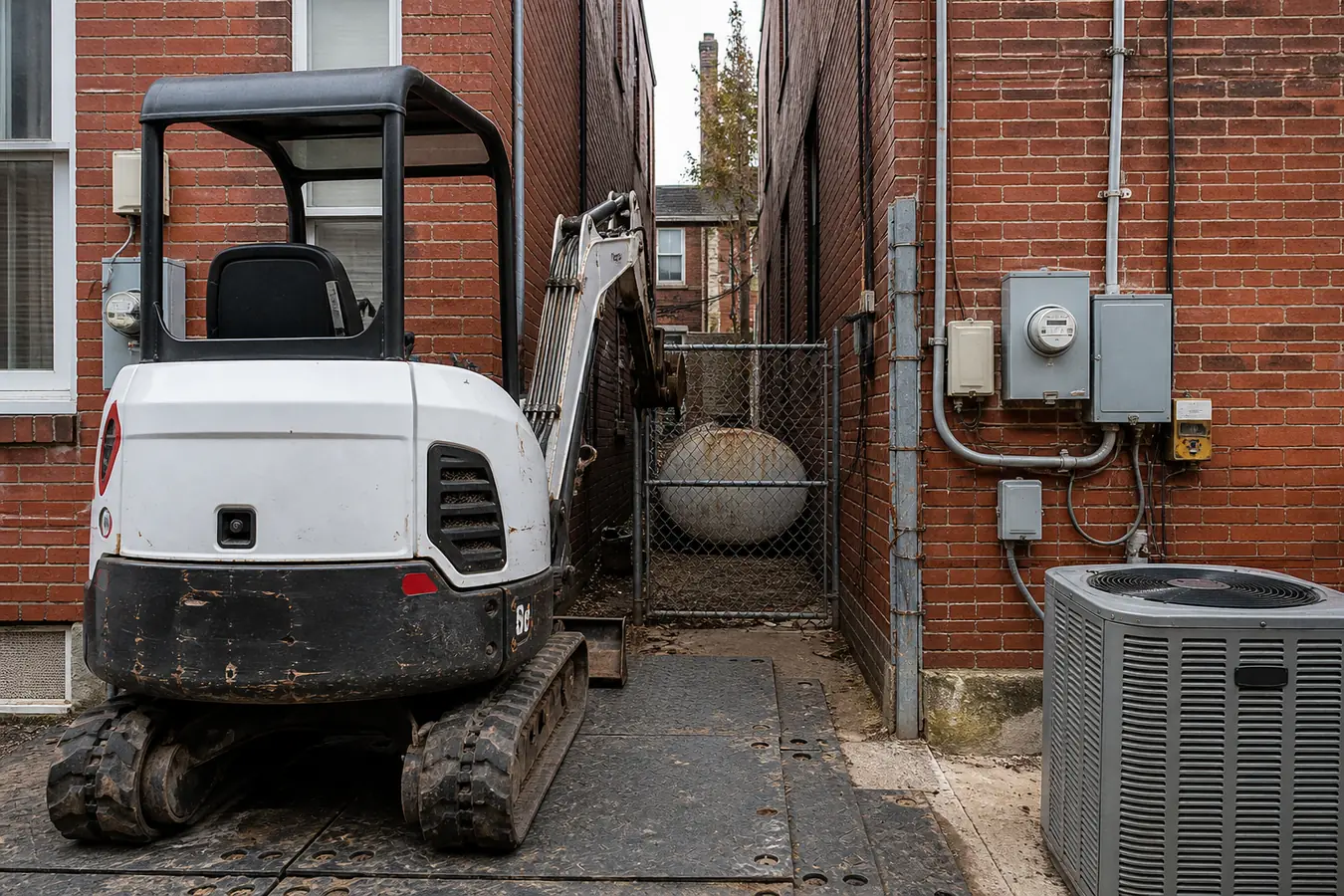
Access, first and largest. A tank reachable by a mini excavator from a driveway is a different cost base from the same tank in a rear yard reached only through the house or a shared alley, which may have to be hand-dug. On Philadelphia lot widths this is the single biggest swing factor and it is why a quote given over the phone is a quote given without the information.
Then depth and what sits on top. A tank under grass is cheap to reach. A tank under a poured driveway, a concrete pad or a patio adds the cut, the removal of the material, and the reinstatement of a surface that has to match what was there.
Then what is still in the tank. Pumping and disposing of standing product and sludge is a real line item, and a tank a third full is a different job from an empty one.
Then the soil. This is the one that can multiply the whole number, and it is the one nobody can price before the samples come back.
Lines To Check Are Actually In The Quote
Soil sampling and laboratory analysis. If it is not itemized, ask whether it is included, because a removal without sampling leaves the question open and is not a closure you can hand to a buyer.
Reinstatement, described specifically. "Backfill and make good" means one thing to a contractor and another to a homeowner looking at a cut driveway. The City's permit plans have to show surface restoration details for an underground tank, so the detail exists somewhere; it should be in your quote too.
Disposal and manifesting of the tank and its contents, and the permit fees as a separate line. A quote with all of this rolled into a single number is not necessarily a bad quote, but it is one you cannot compare with anything.
City of Philadelphia L&I, hazardous material tank permit (checked Aug 2026)
Why We Do Not Publish A Range
A range wide enough to be honest is too wide to be useful, and a range narrow enough to be useful is one that gets revised on the day. Both are worse than a survey.
The figures you will find elsewhere for Pennsylvania removals come from national cost aggregators and from contractors describing their own averages. They are a reasonable sense of scale and a poor basis for a decision about your property. Where this site quotes a number, it is a fee set by an agency and it is dated on the page.
What we will do is look at the property and give you a written figure with what it covers and what would change it. That costs you nothing and it is the only version of this question with a real answer.
The Cost Of Not Doing It
The comparison most homeowners never make is against the cost of the tank being found by someone else. A tank discovered by a buyer's inspector during the inspection window is priced by urgency, and the buyer is holding the deal while the quote comes in.
A tank that leaks into the ground moves the job from removal into remediation, where the number is set by how far the contamination went rather than by how big the tank was. Time is the variable that makes that worse, because a tank that is weeping now is weeping tomorrow as well.
Related
- The Philadelphia PermitL&I fees, who is allowed to do the work, and the sign-off you keep
- Underground Tank RemovalExcavated, inspected in the open hole, hauled and documented
- Basement and Above-Ground TanksCut down and carried out of a rowhouse without opening the ground
- The $4,000 DEP ReimbursementWho qualifies, what the deductible is, and why USTIF is a different fund
Common Questions
- How much does oil tank removal cost in Philadelphia?
- The parts that are fixed are the City fees: $158 per tank for the permit, a $25 filing fee for a one or two family dwelling, a $3 City surcharge and a $4.50 State surcharge. The rest depends on access, depth, what is on top of the tank, how much product is left in it and what the soil turns out to hold, which is why the figure comes after a survey rather than before it.
- Is a basement tank cheaper than a buried one?
- Usually, because there is no excavation and no surface to reinstate. The offsetting factor is the carry-out route: a tank that has to be cut down and brought up a rowhouse stair takes labor that a yard tank does not.
- Why do quotes for the same tank differ so much?
- Most often because they are not quoting the same scope. Sampling, disposal of remaining product, permit fees and reinstatement are the four lines that appear in some quotes and not others, and a quote missing all four will always look cheaper until the invoice arrives.
- Do I pay more if the soil is contaminated?
- Yes, and it is the one variable that can change the order of magnitude. Contaminated soil is excavated and disposed of, and further sampling establishes the extent, so the cost is set by how far it went. Up to $4,000 above a $1,000 deductible may be reimbursable through the Pennsylvania DEP program.
A Written Quote For Your Property
You do not need technical details. The address and where you think the tank sits are enough to start a useful conversation about access, permits and the likely method.
Where This Came From
Every fee, rule and figure on this page came from one of the following, each checked on the date shown. Full citations and links are on the sources page.
- City of Philadelphia, Get a building permit for a tank to store hazardous materials (checked Aug 2026)
- Pennsylvania Department of Environmental Protection, Apply for Underground Oil Tank Cleanup Reimbursement (checked Aug 2026)