Basement and Above-Ground Oil Tank Removal
The tank in the basement is the one most Philadelphia homeowners actually have. A 275 gallon steel tank on legs, sitting where the oil burner used to be, still holding a few inches of sludge twenty years after the house went to gas.
It is a simpler job than a buried tank because nothing is unknown until you dig. It is not always an easier one, because the constraint moves from the ground to the staircase.
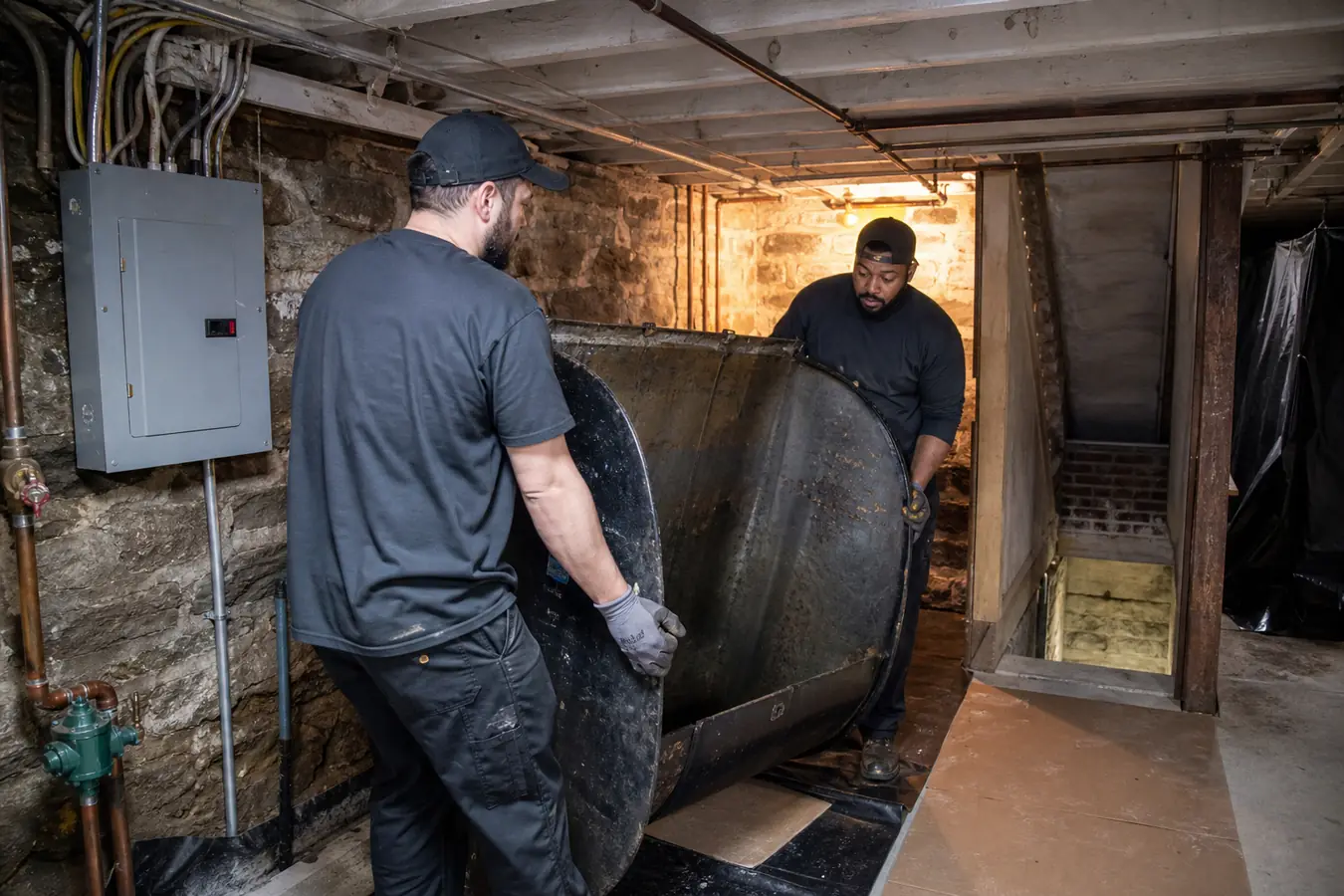
Getting It Out Of A Rowhouse
A 275 gallon tank is roughly five feet long and does not turn a rowhouse stair corner. Almost every basement removal in the city is therefore a cut-and-carry: the tank is drained, cleaned, purged and then cut down into sections small enough to bring up and out.
That is a controlled operation, not a demolition. Cutting into a tank that still holds vapor is the single most dangerous thing that can be done in this trade, which is why the cleaning step comes first and why the tank is confirmed clear before any tool touches it.
Where a house has a bilco door or an exterior basement entry, the route improves and the job gets shorter. That is worth mentioning at survey, because it changes the plan.
Tanks Beside The House And In The Yard
Above-ground tanks against an exterior wall, on a side path or in a rear yard are the easiest version. The tank is drained, cleaned and taken out whole, and the footings or pad it sat on come out with it if you want the ground back.
The one thing to check is what is underneath. An above-ground tank that has been weeping at a seam or a fitting for years leaves a stain on the ground beneath it, and that ground is soil. Where there is any sign of it, sampling is worth doing while everything is exposed rather than after the slab goes back down.
What Is Left Inside, And Where It Goes
Heating oil that has stood for years is not usable fuel. It separates, takes on water and leaves a heavy sludge across the bottom of the tank. It is a disposal item, so nobody is going to credit you for it, and any quote that treats the contents as a bonus is a quote worth reading twice.
The residue is pumped, the tank is cleaned, and the petroleum is manifested and disposed of in accordance with Pennsylvania DEP requirements. The disposal record is part of what you keep.
PA DEP underground storage tanks program (checked Aug 2026)
When A Basement Tank Has Leaked
A basement tank that has failed usually announces itself by smell long before anything is visible, because fuel oil vapor moves through a house through the same paths warm air does. A stained floor around the tank legs, a persistent odor in the finished part of the basement, or oil in a floor drain all mean the situation is different.
Oil that has reached a concrete floor may have gone through it, and a floor drain connects to something. At that point the question is no longer how to get the tank out but what has already left the building, which puts you into the same reporting position as a buried tank. The remediation page sets out what follows.
25 Pa. Code section 245.305, reporting releases (checked Aug 2026)
The Permit Still Applies
A basement tank feels like an interior job, and homeowners regularly assume the City is not involved. It is. Philadelphia requires a building permit to install or remove a hazardous material tank, and the work has to be carried out by a licensed contractor who is current on City taxes and holds current insurance on file with L&I.
The fee is $158 per tank, plus a $25 filing fee for a one or two family dwelling, a $3 City surcharge and a $4.50 State surcharge. Full detail is on the permit page.
City of Philadelphia L&I, hazardous material tank permit (checked Aug 2026)
Related
- Underground Tank RemovalExcavated, inspected in the open hole, hauled and documented
- What It CostsEvery line that moves the number, and the ones nobody quotes for
- The Philadelphia PermitL&I fees, who is allowed to do the work, and the sign-off you keep
- Soil RemediationWhat happens when the ground under the tank turns out to be dirty
Common Questions
- Do I need a permit to remove a tank from my basement in Philadelphia?
- Yes. The City requires a building permit to install or remove a hazardous material tank, and heating oil tanks fall under that regardless of whether the tank is buried or standing on a basement floor. Fees checked August 13, 2026.
- How long does a basement tank removal take?
- An empty, accessible 275 gallon tank is usually a single day including the cut-down and the carry-out. Heavy sludge, a difficult stair, a finished basement that needs protecting, or a second tank all extend it.
- Can the tank be left in the basement if it is empty?
- Physically yes, and plenty of Philadelphia basements still have one. It is not a live compliance problem the way a buried tank can be, but it is still a tank full of residue occupying floor space, and it will come up at sale.
- Is there any value in the scrap steel?
- Very little, and less than people expect once the cleaning and disposal of the contents is accounted for. Treat the scrap as a rounding error rather than an offset against the price of the job.
A Written Quote For Your Property
You do not need technical details. The address and where you think the tank sits are enough to start a useful conversation about access, permits and the likely method.
Where This Came From
Every fee, rule and figure on this page came from one of the following, each checked on the date shown. Full citations and links are on the sources page.
- Pennsylvania Department of Environmental Protection, Underground Storage Tanks (checked Aug 2026)
- 25 Pa. Code Chapter 245, section 245.305 (Reporting releases) (checked Aug 2026)
- City of Philadelphia, Get a building permit for a tank to store hazardous materials (checked Aug 2026)