Oil Tank Removal in West Philadelphia
West Philadelphia has an unusual combination for this work: housing old enough that oil heat was standard, on lots deep enough to actually dig in.
The porch-front Victorian twins and large rows of Cedar Park, Spruce Hill, Walnut Hill and Overbrook mostly went up between the 1890s and the 1920s, and a good many kept rear yards that run well back from the house. That makes it the most workable ground in the older half of the city.
- Typical build era
- 1890s to the 1920s
- Where the tank usually is
- Buried in a deep rear yard
- What usually decides the price
- Whether there is rear access
Old Enough To Have One, Big Enough To Reach It
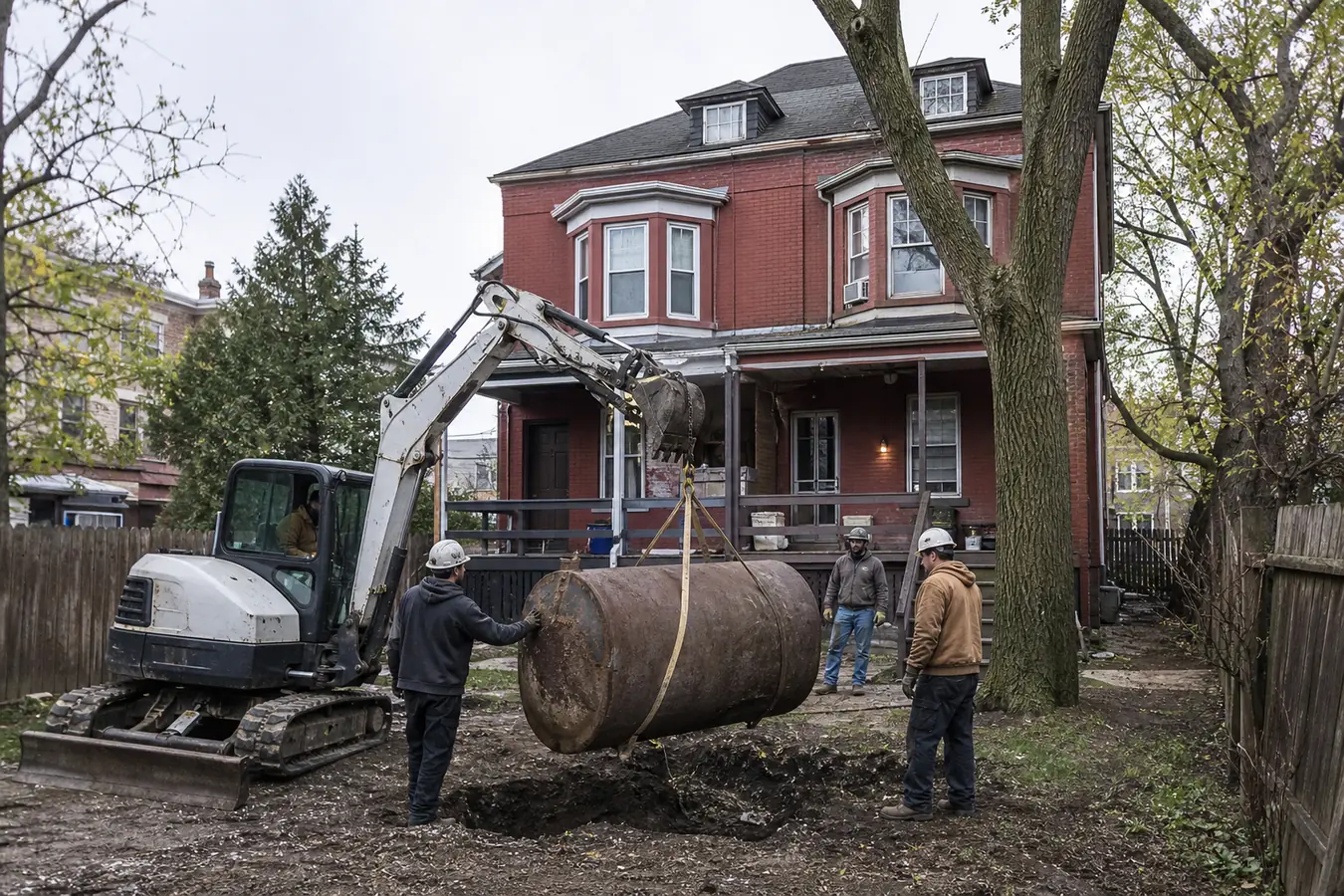
Housing from the 1890s to the 1920s is squarely inside the era when a buried tank was ordinary, so the base rate for a tank here is high. What is unusual is that the yards are deep enough that a tank could be buried a genuine distance from the house, and deep enough that the excavation is not hard against a wall.
Where there is a rear alley, which much of the district has, a machine can often be brought in and the tank lifted out whole. That is the cheapest version of a buried tank removal available anywhere in the older city, and it is worth establishing early because it changes the quote substantially.
Twins Mean Two Owners
A great deal of the district is twins, and a twin has a shared boundary and often a shared path or drive. Where the tank sits close to the party line, or where the route in crosses ground your neighbor uses, that is a conversation to have before the date is booked rather than on the morning.
It matters more than it sounds. Soil sampling near a property line is also the point at which a contaminated result stops being purely your problem, which is covered on the remediation page.
Conversions, Rentals And Absent Records
Large West Philadelphia houses have been divided into apartments and reassembled for a century, and heating systems changed with each round. That leaves properties where nobody currently involved knows what the original system was or where its tank went.
Fill and vent pipes are frequently buried inside later work rather than removed, so the usual visible clues are less reliable here than elsewhere. Where the history is genuinely unknown, a sweep settles it faster than asking, particularly on a property that has changed hands as an investment rather than a home.
Neighborhoods in West Philadelphia
- Overbrook
- Cedar Park
- Walnut Hill
- Cobbs Creek
- Wynnefield
- Spruce Hill
- Kingsessing
- Garden Court
- Haddington
The permit, the fees and the contractor licensing are the same at every address in Philadelphia. They are set out once on the permit page rather than repeated here.
Everywhere Else We Cover
Find your neighborhood A to Z- Northeast PhiladelphiaWhere the build decade tells you the odds before anyone looks
- Northwest PhiladelphiaStone houses on large lots, where reinstatement outweighs removal
- Roxborough and ManayunkThe one district where the constraint is gradient
- South PhiladelphiaThe densest stock in the city, and the carry-out goes through the house
- The River WardsSmall 19th century rows on ground that used to hold industry
- Delaware CountyRowhouse and twin stock, and forty-nine separate permit offices
- Montgomery CountyThe widest spread of tank sizes in the region, from 275 to 1,000 gallons
- Bucks CountyLevittown slab houses and the river boroughs, two different tank problems
- Chester CountyPrivate wells and on-lot septic, which changes what a leak means
Common Questions
- Is West Philadelphia likely to have buried tanks?
- Yes. Most of the district was built between the 1890s and the 1920s, which is inside the period when buried heating oil tanks were ordinary, and the yards were deep enough to make burying one straightforward.
- Why is a quote here lower than for a similar house in South Philly?
- Usually rear access. Where a machine can be brought down an alley into a deep yard, the tank is lifted out whole in a day. Where everything has to be hand dug and carried through the house, the same tank takes considerably more labour.
- Our tank is near the boundary with the other half of the twin. Does that complicate it?
- It needs planning rather than being a problem in itself. The working space and the route in are agreed in advance, and if soil sampling near the line comes back contaminated, the extent has to be established on both sides.
- The house has been apartments for decades and nobody knows the history. Where do we start?
- With a sweep rather than with the deeds. Converted properties frequently have fill and vent lines built into later work, so the visible clues are unreliable and a survey of the ground is the faster answer.
A Written Quote In West Philadelphia
Give us the address and tell us whether the block has a rear alley. That one answer separates a machine excavation from a hand dig, and it moves the quote more than anything else here.
Where This Came From
Every fee, rule and figure on this page came from one of the following, each checked on the date shown. Full citations and links are on the sources page.