Oil Tank Sweep in Philadelphia
A tank sweep is a survey of the ground looking for one thing: a buried tank nobody has disclosed. It is not part of a home inspection and a standard inspection will not find a tank that has been paved over.
On pre-1970 Philadelphia housing with no removal paperwork, it is the cheapest piece of due diligence available and the one most often skipped.
What Gets Surveyed, And How
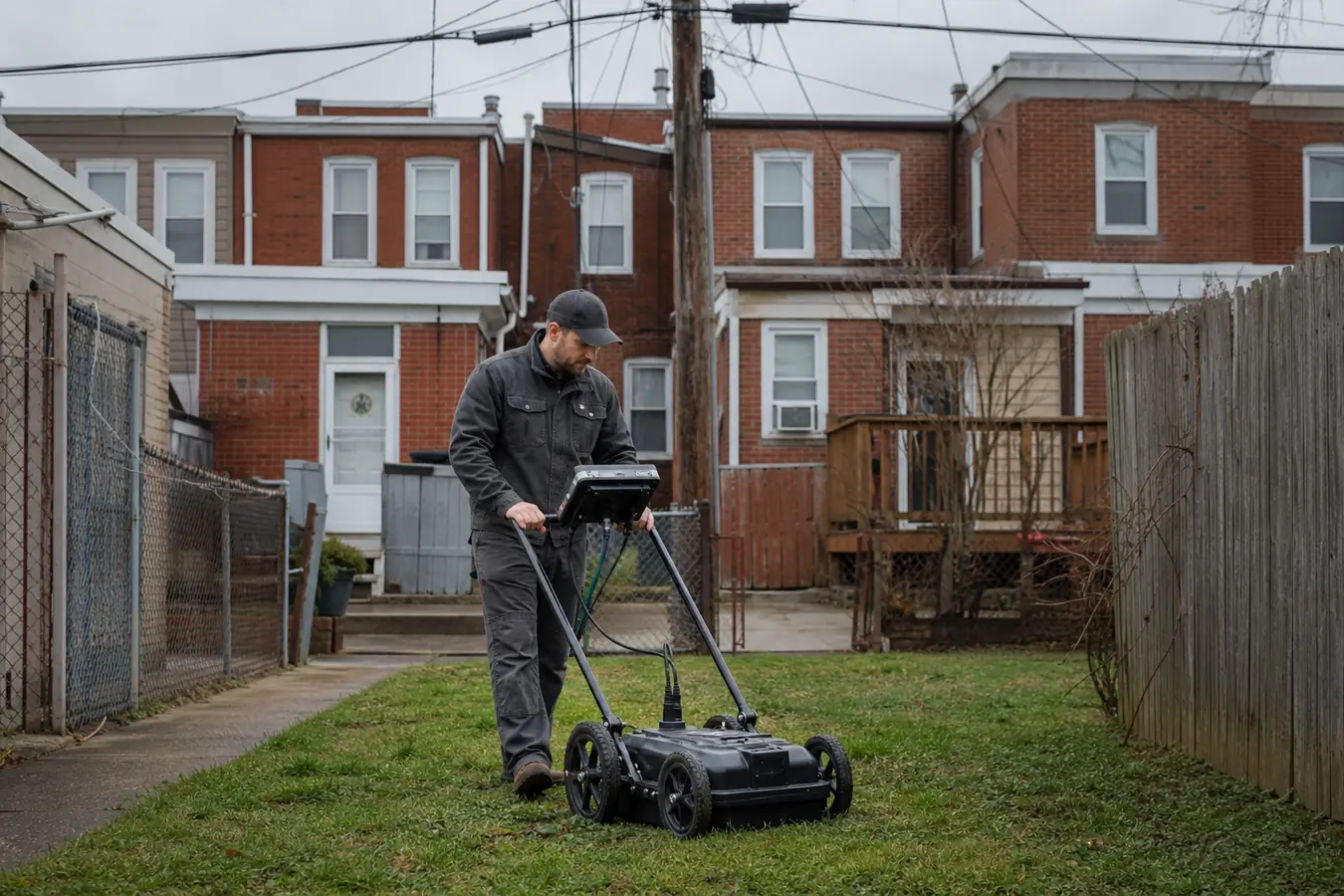
The survey covers the ground around the property where a tank would plausibly sit: yards, side paths, driveways, under paved areas and against the walls where a fill line would have run. It is combined with a walk of the building looking for the physical traces, meaning fill pipes, vent stubs, capped supply lines in a basement and patched brickwork where a line was removed.
Ground penetrating radar is the more accurate method for locating buried tanks. A magnetometer or metal detector finds ferrous metal, which in a Philadelphia rear yard also means old pipe, rebar, buried fencing and a century of discarded iron. Radar reads the shape of what is down there rather than just the presence of metal.
Why It Matters On Philadelphia Housing Stock
Heating oil tanks were standard in properties built between the 1920s and the 1960s, which is most of the rowhouse and twin stock across the Northeast, Olney, Germantown, West Philadelphia and the river wards. When those houses converted to gas, a large share of the tanks were simply left in place and the line was cut.
The result is a city where the absence of a visible tank tells you very little. Rear yards have been concreted, driveways poured and extensions built over the exact spots where tanks sat, and the paperwork from a 1988 conversion does not exist.
What A Clean Sweep Proves, And What It Does Not
A clean sweep is meaningful evidence that no tank is present in the areas surveyed. It is not a guarantee, and anyone selling it as one is overselling it. Radar cannot see reliably through heavily reinforced concrete, and it does not read what is under a building footprint or beyond the surveyed area.
It also says nothing about contamination. A tank that was removed properly in 1995 and a tank that was removed while leaking both leave no tank behind. Where there is evidence a tank was once present, the useful follow-up is soil sampling, not a second sweep.
Timing It Around A Philadelphia Purchase
The sweep belongs in the inspection window, alongside the general inspection, because that is the period in which the finding can still change the deal. A tank found before closing is a negotiation. The same tank found after closing is your tank and your cost.
If a sweep does find something, the sequence is to establish what it is, then decide between removal and a documented closure in place, and to price soil sampling into whichever you choose.
Related
- Buying A House With A TankWhat to settle before closing, and who ends up paying for it
- Underground Tank RemovalExcavated, inspected in the open hole, hauled and documented
- Abandonment In PlaceWhen filling is allowed, and what a lender does with it afterwards
- What It CostsEvery line that moves the number, and the ones nobody quotes for
Common Questions
- Is a tank sweep part of a home inspection?
- No. A general home inspection does not include a subsurface survey. A sweep is a separate engagement looking specifically for a buried tank, and it needs to be arranged as one.
- Who pays for the sweep, the buyer or the seller?
- Usually the buyer, because it is part of their due diligence and it is their risk being surveyed. Sellers of older properties sometimes commission one in advance to take the question off the table before it becomes a mid-deal problem.
- Which is better, ground penetrating radar or a metal detector?
- Radar. A metal detector responds to ferrous metal generally, which in an old Philadelphia yard means a lot of false positives from pipe, rebar and buried scrap. Radar reads the form of the object and is the more accurate technology for locating buried tanks.
- The house has a fill pipe on the wall. Is that proof of a tank?
- It is strong evidence that there was one, not proof that there still is. Fill and vent lines are frequently left in place after a tank is pulled because removing them means opening the wall. A sweep is what distinguishes a leftover pipe from a live tank.
A Written Quote For Your Property
You do not need technical details. The address and where you think the tank sits are enough to start a useful conversation about access, permits and the likely method.
Where This Came From
Every fee, rule and figure on this page came from one of the following, each checked on the date shown. Full citations and links are on the sources page.