Oil Tank Removal in the River Wards
Fishtown, Port Richmond, Kensington and Bridesburg hold some of the oldest small housing in Philadelphia, built for people who worked within walking distance of the river and the mills.
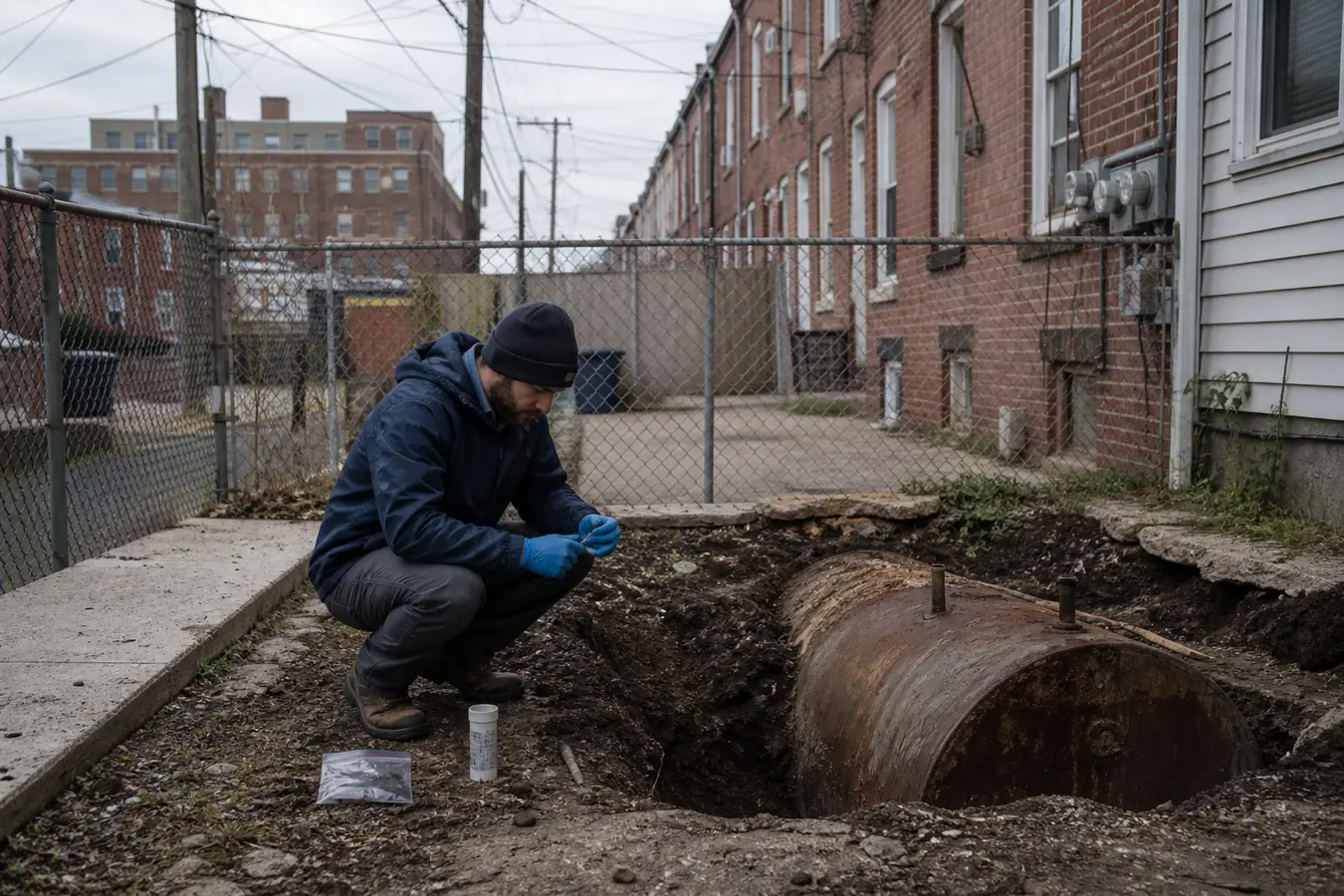
Two things follow for tank work. The houses are small and tight, so the tank is usually indoors or in a yard barely big enough for it. And the ground has an industrial history that predates every tank on the block, which changes how a soil result should be read.
- Typical build era
- 1860s to the 1920s, some earlier
- Where the tank usually is
- Basement, or a very small rear yard
- What usually decides the price
- What the soil result turns out to mean
Small Houses, Trinities And Very Little Yard
Much of this stock is two and three storey rows on narrow lots, including trinities where each floor is a single room stacked on the one below. There is often no rear yard worth the name and no rear access to it.
As in South Philadelphia, that pushes the tank indoors. A basement tank here is drained, cleaned, cut down and carried out, and the constraint is the stair rather than the ground. Where a tank was buried in a small yard, the excavation is a hand dig with the spoil going out through the house.
Conversion and renovation have been intense across these neighborhoods for two decades, which cuts both ways. Some tanks were dealt with properly during a renovation and documented. Plenty were simply built over.
A Soil Result Needs Reading In Context
This is the part that is specific to the river wards. These blocks carried mills, works, yards and fuel storage long before they carried the current housing, and in places the residential and the industrial were on the same street.
That matters because a soil sample tells you what is in the ground, not how it got there. Contamination found under a tank on a block with an industrial past is not automatically from that tank, and establishing the difference is a question for whoever interprets the laboratory result rather than something to assume in either direction.
It does not change your obligation. A confirmed release still has to be reported to DEP's Southeast Regional Office within 24 hours under 25 Pa. Code section 245.305, and the remediation page sets out what follows.
25 Pa. Code section 245.305, reporting releases (checked Aug 2026)PA DEP Southeast Regional Office (checked Aug 2026)
Renovation Is When This Surfaces
Across these neighborhoods the tank question usually arrives attached to something else: a gut renovation, a basement being dug out for headroom, a rear extension, or a sale into a market that moves quickly.
A basement being lowered is the one to watch. Excavating a floor slab in a house that was heated by oil is the moment a forgotten tank, or the ground under one, turns up, and it turns up mid-project with trades already booked. Finding out first is considerably cheaper than finding out then.
Neighborhoods in The River Wards
- Fishtown
- Port Richmond
- Kensington
- Bridesburg
- Northern Liberties
- Olde Richmond
- East Kensington
- Juniata
The permit, the fees and the contractor licensing are the same at every address in Philadelphia. They are set out once on the permit page rather than repeated here.
Everywhere Else We Cover
Find your neighborhood A to Z- Northeast PhiladelphiaWhere the build decade tells you the odds before anyone looks
- Northwest PhiladelphiaStone houses on large lots, where reinstatement outweighs removal
- Roxborough and ManayunkThe one district where the constraint is gradient
- South PhiladelphiaThe densest stock in the city, and the carry-out goes through the house
- West PhiladelphiaVictorian twins with deep rear yards, the easiest digging in the old city
- Delaware CountyRowhouse and twin stock, and forty-nine separate permit offices
- Montgomery CountyThe widest spread of tank sizes in the region, from 275 to 1,000 gallons
- Bucks CountyLevittown slab houses and the river boroughs, two different tank problems
- Chester CountyPrivate wells and on-lot septic, which changes what a leak means
Common Questions
- Do trinities and small rows have oil tanks?
- Often, but indoors. There is rarely enough yard to make burying a tank practical on this stock, so a basement tank is the more common find, and it is removed by cutting it down and carrying it out.
- Our block used to be industrial. Does contamination automatically mean our tank leaked?
- No, and that is the point worth being careful about. A soil result establishes what is in the ground, not its origin. On a block with an industrial history the interpretation matters, and it should be made by whoever reads the laboratory result rather than assumed.
- We are lowering the basement floor. Should we deal with the tank first?
- Yes. Excavating a slab in a house that was heated by oil is exactly when a forgotten tank or contaminated ground appears, and discovering it with trades already on site is the expensive version.
- Who do we report a leak to?
- DEP's Southeast Regional Office in Norristown, on 484-250-5900, no later than 24 hours after a release is confirmed under 25 Pa. Code 245.305. The statewide emergency line is 800-541-2050 and is monitored around the clock.
A Written Quote In The River Wards
Give us the address, and say if a renovation is booked. Dealing with a tank before trades arrive is far cheaper than finding one under a slab you are already lowering.
Where This Came From
Every fee, rule and figure on this page came from one of the following, each checked on the date shown. Full citations and links are on the sources page.
- 25 Pa. Code Chapter 245, section 245.305 (Reporting releases) (checked Aug 2026)
- Pennsylvania Department of Environmental Protection, Southeast Regional Office (checked Aug 2026)