Oil Tank Removal in Northeast Philadelphia
The Northeast is the one part of Philadelphia where you can narrow the odds before anyone visits, because the district was built outward in clearly dated waves and heating oil was standard for only some of them.
It is also, for once, good news on the practical side. Driveways, garages and setbacks are normal here in a way they are not in the older half of the city, which usually means a machine can reach the tank.
- Typical build era
- 1920s to 1960s, and it varies by street
- Where the tank usually is
- Buried in the yard or under a driveway
- What usually decides the price
- Depth and what is paved over it
Reading Your Build Decade Off The Map
Roosevelt Boulevard opened in 1914 and pulled development after it. Mayfair, Lawndale and the Northwood section of Frankford saw significant construction immediately south of Cottman Avenue and along the Boulevard during the 1920s and early 1930s, which is squarely inside the era when a new house was heated by oil.
The Near Northeast came next. Builders expanded west of Roosevelt Boulevard into Rhawnhurst, Lawndale and Oxford Circle in the late 1940s and 1950s, the peak of the postwar rowhouse boom and still oil territory for a large share of it.
The Far Northeast is the exception. It stayed largely undeveloped until the late 1950s and 1960s, when Cape Cod and ranch dwellings went up in Bustleton and Somerton and mixed row and single-family housing followed east of the Boulevard in Torresdale, Holme Circle and Academy Gardens. That is late enough that gas was arriving, so a tank there is less likely and more of a surprise when it turns up.
Encyclopedia of Greater Philadelphia, Northeast Philadelphia (checked Aug 2026)
The Easiest Ground In The City To Work
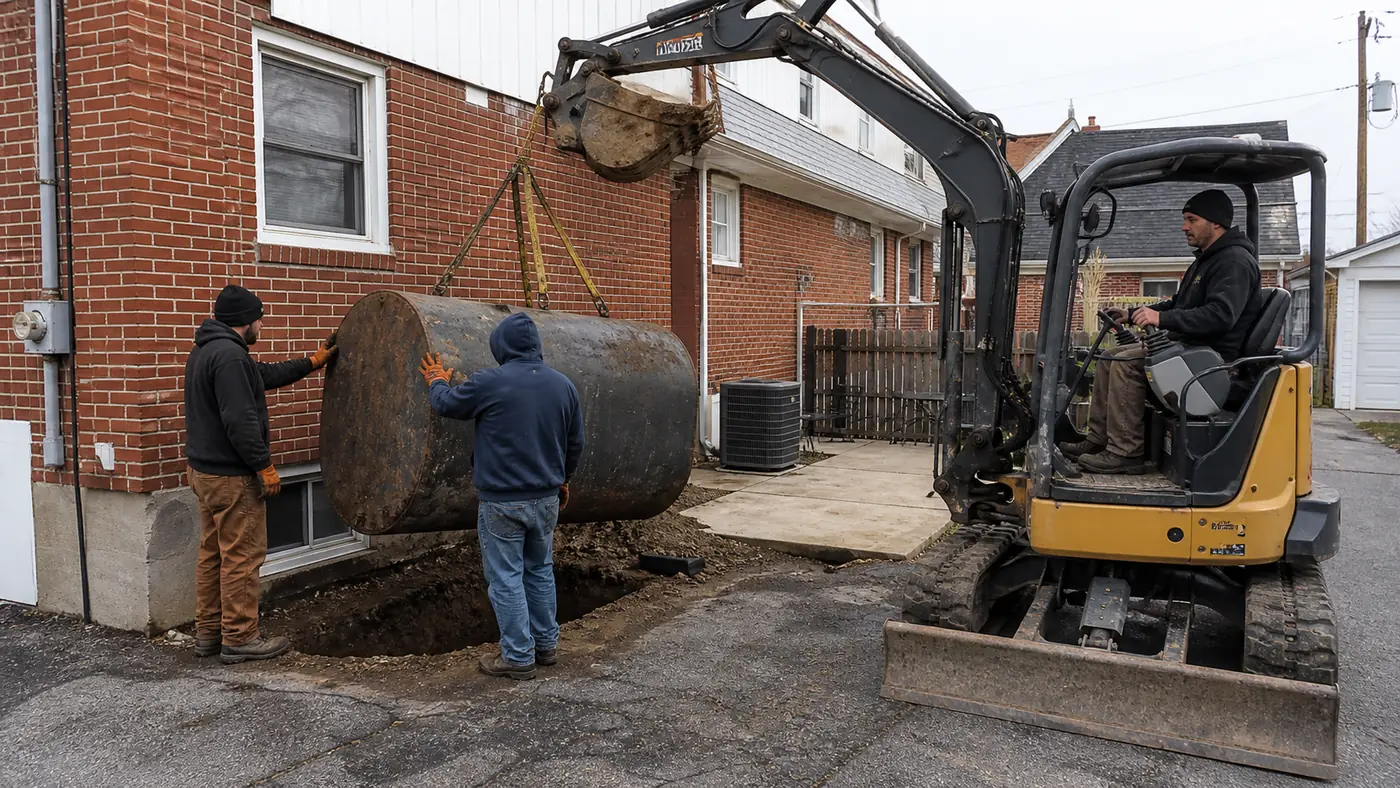
A driveway changes everything about this job. Where a mini excavator can be walked to the tank, a removal that would take two days by hand in a South Philadelphia yard is a single day, and the tank comes out whole rather than being cut into sections.
Rear service drives behind the row blocks help just as much. Where the older parts of the city have no rear access at all, much of the Northeast has a paved way in, which keeps machinery, spoil and the haulage truck out of the house entirely.
The trade-off is what sits on top. A tank under a concrete driveway apron or a poured patio means the surface has to be cut and put back, and on these blocks the reinstatement is frequently the line the homeowner cares most about. It is also the line the City wants answered in advance, because the permit plans have to show surface restoration details for an underground tank.
City of Philadelphia L&I, hazardous material tank permit (checked Aug 2026)
Cape Cods, Ranches And Above-Ground Tanks
The Far Northeast housing types behave differently from the rest of the city. A Cape Cod or a ranch on a wider lot is more likely to have had an above-ground tank in a garage or against the house than a buried one in the yard, and more likely again to have been gas from the start.
That does not make a sweep pointless, it makes it cheaper to justify. On a wider lot there is more ground to be uncertain about, and the tank sweep page covers what a survey does and does not settle.
Neighborhoods in Northeast Philadelphia
- Mayfair
- Rhawnhurst
- Oxford Circle
- Lawndale
- Fox Chase
- Bustleton
- Somerton
- Torresdale
- Holme Circle
- Academy Gardens
- Frankford
- Northwood
- Tacony
- Castor Gardens
The permit, the fees and the contractor licensing are the same at every address in Philadelphia. They are set out once on the permit page rather than repeated here.
Everywhere Else We Cover
Find your neighborhood A to Z- Northwest PhiladelphiaStone houses on large lots, where reinstatement outweighs removal
- Roxborough and ManayunkThe one district where the constraint is gradient
- South PhiladelphiaThe densest stock in the city, and the carry-out goes through the house
- West PhiladelphiaVictorian twins with deep rear yards, the easiest digging in the old city
- The River WardsSmall 19th century rows on ground that used to hold industry
- Delaware CountyRowhouse and twin stock, and forty-nine separate permit offices
- Montgomery CountyThe widest spread of tank sizes in the region, from 275 to 1,000 gallons
- Bucks CountyLevittown slab houses and the river boroughs, two different tank problems
- Chester CountyPrivate wells and on-lot septic, which changes what a leak means
Common Questions
- Does my Mayfair rowhouse have an oil tank?
- Possibly. Mayfair saw significant construction in the 1920s and early 1930s, which is inside the period when new houses were routinely heated by oil. That makes it a candidate rather than a certainty, and a fill or vent pipe on the wall is the first thing to look for.
- Is a Far Northeast house less likely to have a tank?
- Generally yes. Bustleton and Somerton were largely built in the late 1950s and 1960s, late enough that gas was displacing oil, so tanks are less common there than in the Near Northeast or along Roosevelt Boulevard.
- Will you need to come through the house?
- Usually not in the Northeast, which is the advantage of the district. Where there is a driveway or a rear service drive, the machinery, the spoil and the tank all stay outside.
- The tank is under my driveway. What happens to the concrete?
- It is cut, the tank comes out, and the surface is reinstated to what was agreed before the work started. The City requires the permit plans to show the surface restoration details for an underground tank, so the answer exists in writing before anyone breaks ground.
A Written Quote In Northeast Philadelphia
Give us the address and the block. In the Northeast the build decade does most of the guessing for us, and a driveway or a rear service drive usually means the tank comes out whole in a day.
Where This Came From
Every fee, rule and figure on this page came from one of the following, each checked on the date shown. Full citations and links are on the sources page.
- Encyclopedia of Greater Philadelphia (Rutgers-Camden), Northeast Philadelphia (checked Aug 2026)
- City of Philadelphia, Get a building permit for a tank to store hazardous materials (checked Aug 2026)