Oil Tank Soil Remediation in Philadelphia
Most tank removals end with a clean soil result and nothing further to do. A minority do not, and that minority is where the money and the anxiety live.
This page sets out what actually follows a contaminated sample in Philadelphia: what has to be reported, to whom, how quickly, and what the cleanup involves.
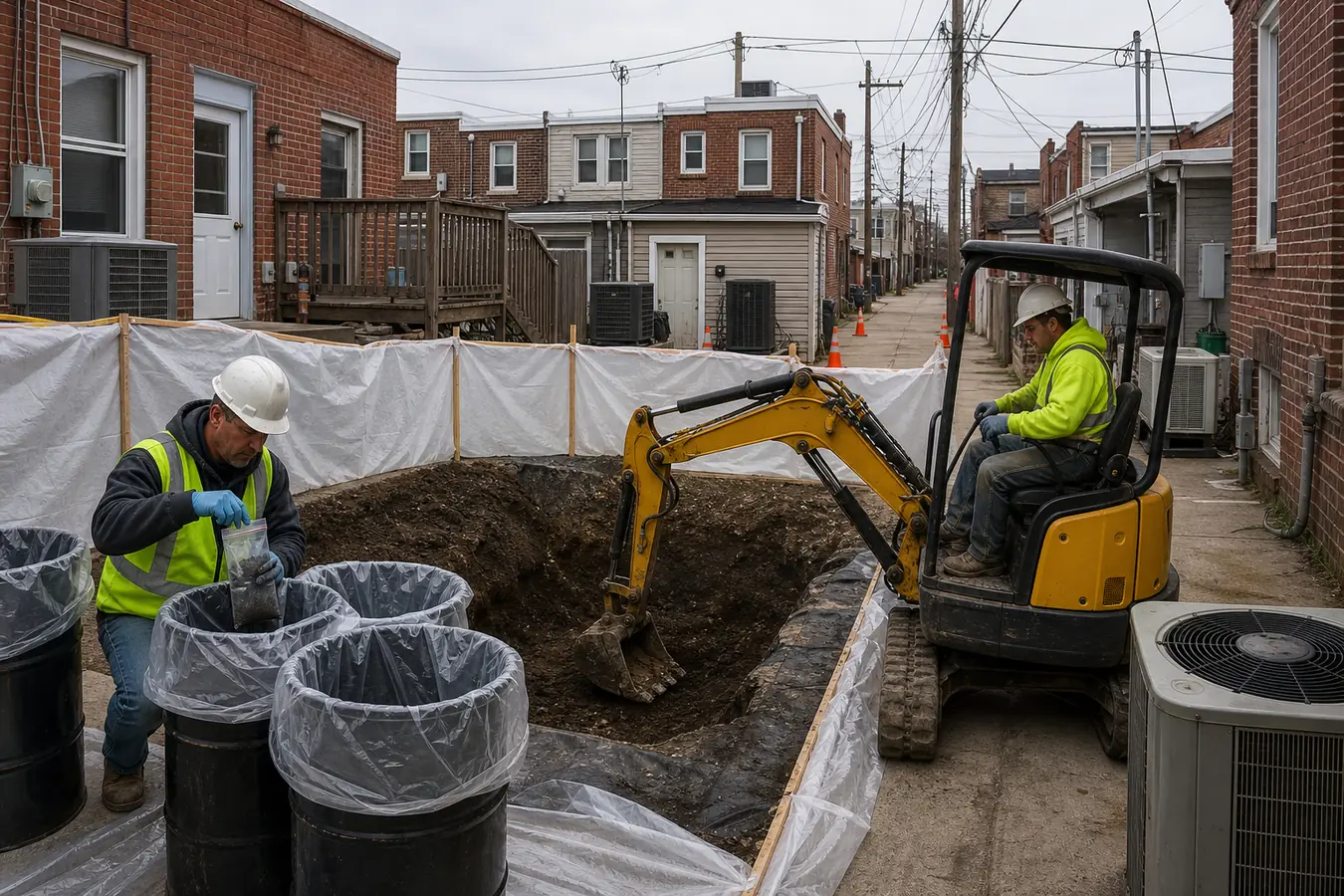
How A Leak Gets Confirmed
Contamination is confirmed by laboratory analysis of soil taken from beneath and around the tank, not by how the ground looks or smells in the hole. Stained soil and a strong odor are why samples get taken; the result is what establishes the position.
This is the argument for sampling at the point of removal rather than skipping it. The samples cost a fraction of reopening the ground later, and a clean result is a permanent answer rather than an absence of information.
The 24 Hour Reporting Rule
Under 25 Pa. Code section 245.305, the owner or operator has to notify the appropriate DEP regional office as soon as practicable and no later than 24 hours after a release is confirmed. That is a real deadline attached to the property owner, not to the contractor.
There is a narrow exception, and it is worth knowing precisely because it is often misquoted. Reporting and further corrective action are not required where the owner has control of the release, it is completely contained, and the entire volume is recovered and removed within 24 hours, which includes a petroleum release to an above-ground surface of less than 25 gallons. A tank that has been seeping into soil for years satisfies none of those conditions.
Heating oil, for the purposes of the chapter, covers the standard fuel oil grades used in heating equipment, boilers and furnaces, which is what a residential tank holds.
25 Pa. Code section 245.305, reporting releases (checked Aug 2026)25 Pa. Code section 245.1, definitions (checked Aug 2026)
Who The Report Actually Goes To
The regulation says the appropriate regional office, which is not much use at nine on a Friday evening. For every county this site covers it is the same one. DEP's Southeast Regional Office at 2 E Main Street, Norristown PA 19401 serves Bucks, Chester, Delaware, Montgomery and Philadelphia, and its main line, 484-250-5900, is answered 24 hours.
There is also a Commonwealth-wide environmental emergency number, 800-541-2050, monitored 24 hours a day every day of the year. For a release found late in the day or over a weekend, that is the one to use rather than waiting for office hours to open inside a 24 hour deadline.
On a job we are running, the notification is made by us. The duty under section 245.305 still sits with the owner or operator, which is why the number is printed here rather than kept in a contractor's phone.
PA DEP Southeast Regional Office (checked Aug 2026)25 Pa. Code section 245.305, reporting releases (checked Aug 2026)
What The Cleanup Involves
Contaminated soil is excavated and disposed of, and further samples from the sides and base of the enlarged excavation establish whether the contamination has been removed or whether it continues. That is the loop: dig, sample, read, decide. It is why nobody can price a remediation accurately on day one.
How far it goes depends on how long the tank leaked, how much product left it, and what the ground is made of. Contamination that has reached beneath a foundation, under a neighboring property or into groundwater is a materially larger undertaking than a stained pocket directly under the tank, and the honest thing a contractor can do is tell you which of those you appear to have as soon as it is visible.
The Reimbursement Most Homeowners Miss
Pennsylvania runs an Underground Heating Oil Tank Cleanup Reimbursement Program for tanks of 3,000 gallons or less that stored heating fuel used on the premises. Where there was a release from the tank, its lines, a spill or an overfill, occurring or discovered on or after January 30, 1998, the tank owner pays the first $1,000 and can be reimbursed for eligible costs above that up to a maximum of $4,000.
Claims go through the Pennsylvania Electronic Single Application system with itemized invoices and proof of payment, which is a reason to keep the invoicing clean and itemized from the start. The reimbursement guide works through the eligibility questions one at a time, including why the separate USTIF fund does not apply to a standard residential tank.
PA DEP heating oil tank cleanup reimbursement (checked Aug 2026)
What Nobody Can Tell You On Day One
The final cost. Anyone who quotes a fixed price for a remediation before the extent is known is either guessing or building in a margin large enough to cover the guess, and both come out of your pocket.
What can be established early is the shape of it: whether the contamination is confined to the tank pit, whether it appears to run under a structure, and whether it looks like a matter of extra cubic yards or a matter of a groundwater investigation. That assessment is worth more than a number that is going to change anyway.
Related
- The $4,000 DEP ReimbursementWho qualifies, what the deductible is, and why USTIF is a different fund
- Underground Tank RemovalExcavated, inspected in the open hole, hauled and documented
- What It CostsEvery line that moves the number, and the ones nobody quotes for
- Basement and Above-Ground TanksCut down and carried out of a rowhouse without opening the ground
Common Questions
- Who has to report an oil leak in Pennsylvania, me or the contractor?
- The obligation under 25 Pa. Code 245.305 sits with the owner or operator, and the notification has to reach the appropriate DEP regional office as soon as practicable and no later than 24 hours after the release is confirmed. For Philadelphia and the four collar counties that is the Southeast Regional Office in Norristown on 484-250-5900, answered 24 hours, or the statewide emergency line on 800-541-2050. In practice the contractor who found it makes the call, but the duty is yours.
- Does homeowners insurance cover oil tank cleanup?
- Some policies respond and many exclude pollution from a storage tank outright. It depends entirely on the policy wording and the age of the release, so the answer has to come from your own policy and your carrier rather than from a general rule.
- How much of the cleanup can I get reimbursed?
- Up to $4,000 of eligible costs through the Pennsylvania DEP program for underground heating oil tanks of 3,000 gallons or less, after a $1,000 deductible paid by the tank owner, where the release occurred or was discovered on or after January 30, 1998. Figures checked August 13, 2026.
- Can contamination spread to my neighbor's property?
- It can, and on Philadelphia lot widths a tank near a property line makes that a real question rather than a theoretical one. Establishing the extent is exactly what the sampling around an enlarged excavation is for.
A Written Quote For Your Property
You do not need technical details. The address and where you think the tank sits are enough to start a useful conversation about access, permits and the likely method.
Where This Came From
Every fee, rule and figure on this page came from one of the following, each checked on the date shown. Full citations and links are on the sources page.
- 25 Pa. Code Chapter 245, section 245.305 (Reporting releases) (checked Aug 2026)
- 25 Pa. Code Chapter 245, section 245.1 (Definitions) (checked Aug 2026)
- Pennsylvania Department of Environmental Protection, Southeast Regional Office (checked Aug 2026)
- Pennsylvania Department of Environmental Protection, Apply for Underground Oil Tank Cleanup Reimbursement (checked Aug 2026)