Survey the property
We confirm the tank position and size, check access from the street to the tank, and identify what has to be protected on the route.
We remove buried and basement heating oil tanks across Philadelphia and the collar counties, file the City permit, sample the soil while the hole is open, and hand you the paperwork that closes the question for good.
A Written Quote For Your Property
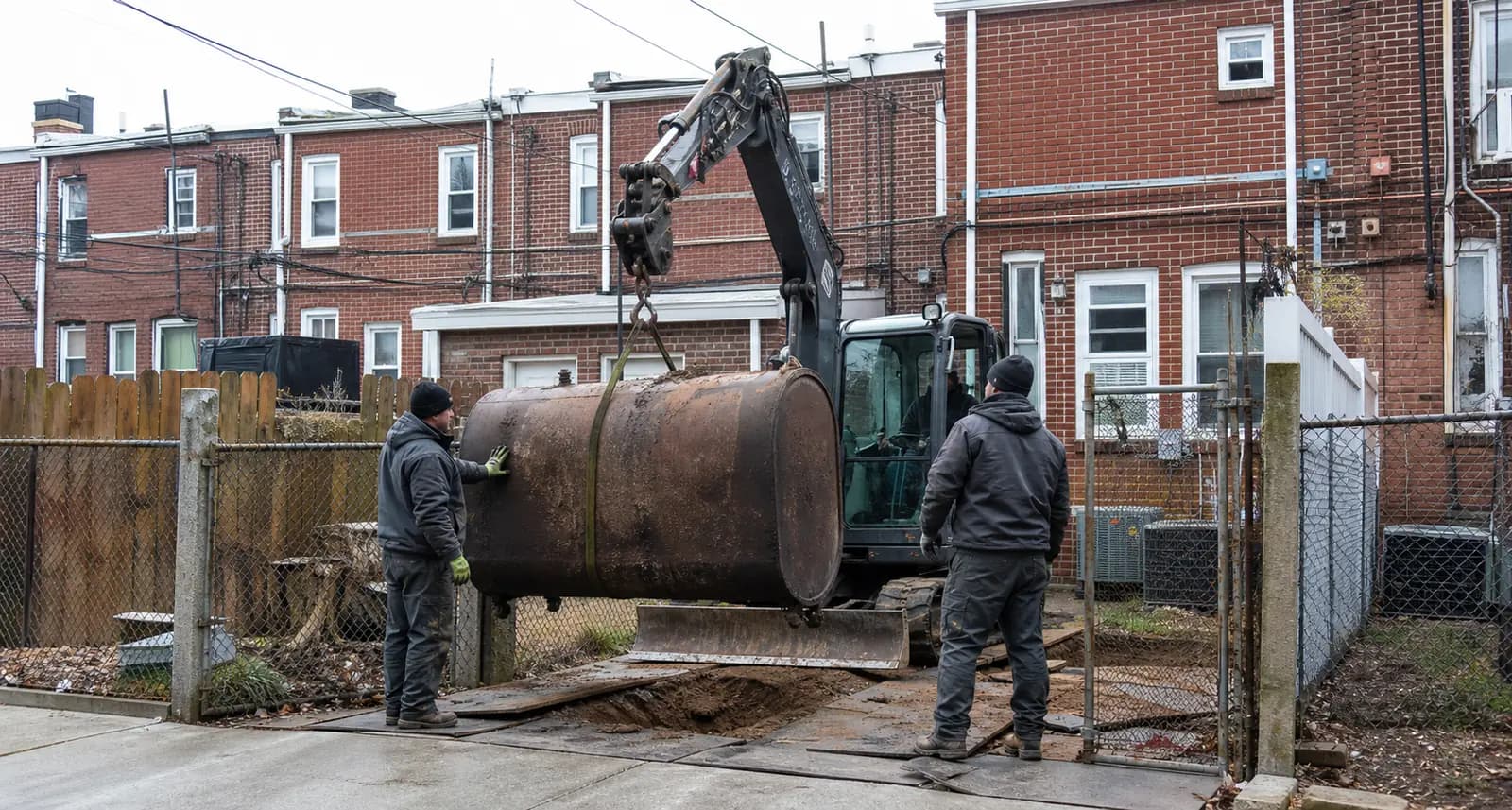
A tank looks straightforward until access, remaining product and the soil underneath are considered together. Those questions get settled before equipment arrives, not on the day.
A tank under a Philadelphia rowhouse yard is a different job from the same tank in a Bucks County driveway, because the working space, the machine that fits and the reinstatement all change. We establish what is actually there before quoting, not after.
Read the full pageAccess decides the method more often than the tank does. On a narrow street with no rear access, a basement tank gets cut down and carried out in sections, and a buried tank in a 14 foot yard may need hand digging rather than a machine.
Read the full pageRemaining product is pumped, the tank is cleaned, and the petroleum is manifested for disposal. This is scoped up front so the crew arrives with the right equipment rather than discovering 60 gallons of sludge on the day.
Read the full pageThe samples are the part that matters six months later. A clean result is the document that closes the question for a buyer, a lender or a title company. A bad result starts a different process, and we tell you that on the day rather than at the end.
Read the full pageSurvey, permit, removal, sampling and reinstatement run as a single job with one handover at the end. You are not left coordinating a contractor, a laboratory and the City yourself.
We confirm the tank position and size, check access from the street to the tank, and identify what has to be protected on the route.
Philadelphia requires a building permit to remove the tank, and it has to be pulled by a licensed contractor. That paperwork is ours, not yours.
The tank is emptied, cleaned, removed or cut out, and the soil beneath it is sampled while the excavation is still open.
The area is backfilled and the surface made good, and you get the permit sign-off and the sampling result as one record.
The City treats a heating oil tank as a hazardous material tank. You need a building permit from the Department of Licenses and Inspections to install or remove one, and the work has to be done by a licensed contractor who is current on City taxes and has insurance on file with L&I. Where the tank falls under Pennsylvania DEP regulation, the contractor also has to hold a DEP Company Certification in the applicable category.
The fees are published. Filing is $25 for a one or two family dwelling and $100 for anything else, the permit itself is $158 per tank, and there is a $3 City surcharge and a $4.50 State surcharge on top. Plans have to show the tank location, the storage capacity, and the surface restoration details for an underground tank, which is the line most homeowners do not expect.
At the end, a Certificate of Approval is issued once the required inspections pass. That certificate is the thing worth having. It is what a buyer's attorney, a title company or a lender asks for, and it is the difference between a tank that was removed and a tank you can prove was removed.
City of Philadelphia L&I, hazardous material tank permit (checked Aug 2026)
Residential heating oil tanks sit outside most of the registration regime that applies to commercial tanks, but that changes the moment there is a release. Under 25 Pa. Code section 245.305, the owner has to notify the appropriate DEP regional office as soon as practicable and no later than 24 hours after a release is confirmed.
There is a narrow exception. Reporting and corrective action are not required where the owner has control of the release, it is completely contained, and the whole volume is recovered and removed within 24 hours, which includes a petroleum release to an above-ground surface of less than 25 gallons. A tank that has been weeping into the ground for years does not meet any part of that test.
The practical consequence is that the sampling decision is not really optional. If the soil under the tank is contaminated and nobody looks, the obligation still exists and the discovery just moves to a worse moment, usually mid-sale.
25 Pa. Code section 245.305, reporting releases (checked Aug 2026)25 Pa. Code section 245.1, definitions (checked Aug 2026)
Pennsylvania runs an Underground Heating Oil Tank Cleanup Reimbursement Program for tanks of 3,000 gallons or less that stored fuel used for heating on the premises. If there was a release from the tank, its lines, a spill or an overfill, and it occurred or was discovered on or after January 30, 1998, the owner can claim. The tank owner pays the first $1,000 and can be reimbursed for eligible costs above that, up to a maximum of $4,000.
That covers the standard residential 275 and 550 gallon tank. It is claimed through the Pennsylvania Electronic Single Application system with itemized invoices and proof of payment, which means the invoices need to be right the first time.
It is worth being precise about the other fund, because the two get confused constantly. The Underground Storage Tank Indemnification Fund runs a voluntary heating oil program, but that one applies to nonregulated underground heating oil tanks of 3,000 gallons or greater. A 275 gallon tank in a Mayfair backyard is a DEP reimbursement matter, not a USTIF matter. The reimbursement guide works through both.
PA DEP heating oil tank cleanup reimbursement (checked Aug 2026)PA Underground Storage Tank Indemnification Fund, heating oil tanks (checked Aug 2026)
We do not quote a price for a tank we have not seen. Every number published anywhere for oil tank removal is a range, because depth, access, remaining product and what the soil turns out to hold are all unknown until someone looks. A firm figure before a survey is a figure that changes later.
We do not recommend filling a tank in place because it is cheaper. It sometimes is the right call, and the abandonment page sets out when. But an abandoned tank with no documentation is the single most common reason a Philadelphia sale stalls, and saving a few hundred dollars now to lose a closing later is not a saving.
We do not carry out the sampling and then keep the result to ourselves. You get the laboratory result whether it is clean or not, because the clean one is the asset and the bad one is information you are legally better off holding.
The permit and the licensing are identical at every Philadelphia address. What changes from one part of the region to another is the ground, the build decade, whether anything with an engine can reach the tank, and, once you cross the city line, which office issues the permit at all.
You do not need technical details. The address and where you think the tank sits are enough to start a useful conversation about access, permits and the likely method.
Every fee, rule and figure on this page came from one of the following, each checked on the date shown. Full citations and links are on the sources page.