Oil Tank Removal in South Philadelphia
South Philadelphia is the tightest ground in the city to work in, and it changes the job in a way that surprises people who have had a tank removed somewhere else.
Two-storey rows on narrow lots, minimal rear yards, no driveways and in many blocks no rear alley. There is often nowhere to dig and no way to reach it if there were, which is why the tank here is far more likely to be standing in the basement than buried behind the house.
- Typical lot
- Two-storey row, minimal or no rear yard
- Where the tank usually is
- In the basement far more often than buried
- What usually decides the price
- The route from the tank to the street
Why The Tank Is Usually Indoors
Where a house has twelve feet of frontage and a yard you can cross in three steps, burying a tank was never the obvious choice. Across a great deal of South Philadelphia the tank went into the basement instead, sitting on the floor beside where the oil burner used to be, and a large number of them are still there.
That is the better outcome. Nothing has to be excavated, no surface has to be reinstated, and the soil question does not arise unless the tank has been leaking onto the floor. It is a one day job on most blocks, covered on the basement tank page.
Where a tank was buried, it is typically in the small rear yard or under the concrete pad that has replaced it, and the excavation is almost always by hand. There is no route for a machine.
Everything Goes Out Through The Front Door
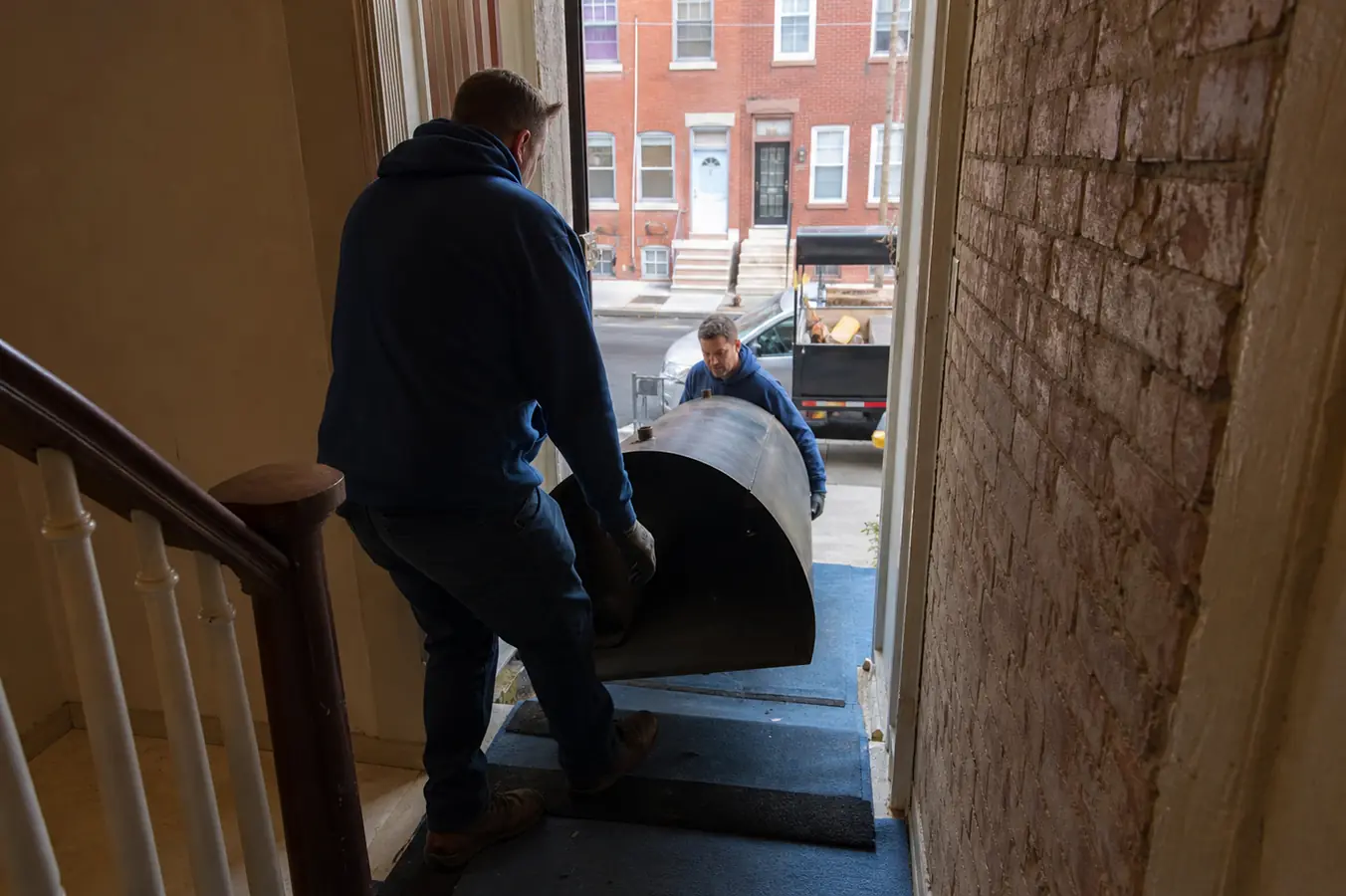
A 275 gallon tank is roughly five feet long and does not turn a South Philadelphia stair. It is drained, cleaned, purged, confirmed clear and then cut down into sections small enough to bring up and carry out, and on these houses the route runs through the living space.
That means protection of floors, walls and stair edges is part of the work rather than a courtesy, and it is worth asking any contractor what they intend to lay down before they start. It also means the crew is in your house for the day rather than in the yard.
The occasional house with a bilco door or an exterior basement entry is a materially easier job, so it is worth mentioning at survey if you have one.
The Street Is Part Of The Schedule
On blocks where every space is taken and the street is one lane wide with cars both sides, where the truck stands is a genuine planning question rather than a detail. It affects the carry distance, and on the tightest blocks it affects which day the work can happen.
This is also why quotes for what looks like an identical tank vary so much across the district. A Girard Estate house with a driveway and a Point Breeze row with neither driveway nor rear alley are the same tank and different jobs, which the cost page works through.
Neighborhoods in South Philadelphia
- Passyunk Square
- Point Breeze
- Girard Estate
- Pennsport
- Whitman
- Grays Ferry
- Newbold
- Dickinson Narrows
- Packer Park
- Queen Village
The permit, the fees and the contractor licensing are the same at every address in Philadelphia. They are set out once on the permit page rather than repeated here.
Everywhere Else We Cover
Find your neighborhood A to Z- Northeast PhiladelphiaWhere the build decade tells you the odds before anyone looks
- Northwest PhiladelphiaStone houses on large lots, where reinstatement outweighs removal
- Roxborough and ManayunkThe one district where the constraint is gradient
- West PhiladelphiaVictorian twins with deep rear yards, the easiest digging in the old city
- The River WardsSmall 19th century rows on ground that used to hold industry
- Delaware CountyRowhouse and twin stock, and forty-nine separate permit offices
- Montgomery CountyThe widest spread of tank sizes in the region, from 275 to 1,000 gallons
- Bucks CountyLevittown slab houses and the river boroughs, two different tank problems
- Chester CountyPrivate wells and on-lot septic, which changes what a leak means
Common Questions
- Is my South Philly tank in the basement or the yard?
- In this district the basement is the more common answer, because the lots were never big enough to make burying a tank the obvious choice. A capped line coming through the basement wall, or a fill pipe on the front or side, tells you which you are dealing with.
- Do you have to bring it through my living room?
- On most South Philadelphia rows, yes. The tank is cleaned and made safe, cut into sections and carried out, and the route through the house is protected before anything moves. A bilco door or an exterior basement entry avoids it where the house has one.
- There is no rear alley on our block. Does that stop a buried tank being removed?
- No, but it means the excavation is by hand rather than by machine, because there is no route to get a machine into the yard. That is normal here and it is priced as labour rather than as a problem.
- Do I need to arrange parking?
- It helps enormously. Where the truck can stand close, the carry is short and the day is shorter. On the tightest blocks it is the single thing a homeowner can do that most affects how the job runs.
A Written Quote In South Philadelphia
Give us the address and say whether the tank is in the basement. If it is, this is usually a single day, and the only thing worth arranging in advance is somewhere for the truck to stand.
Where This Came From
Every fee, rule and figure on this page came from one of the following, each checked on the date shown. Full citations and links are on the sources page.