Oil Tank Removal in Chester County, PA
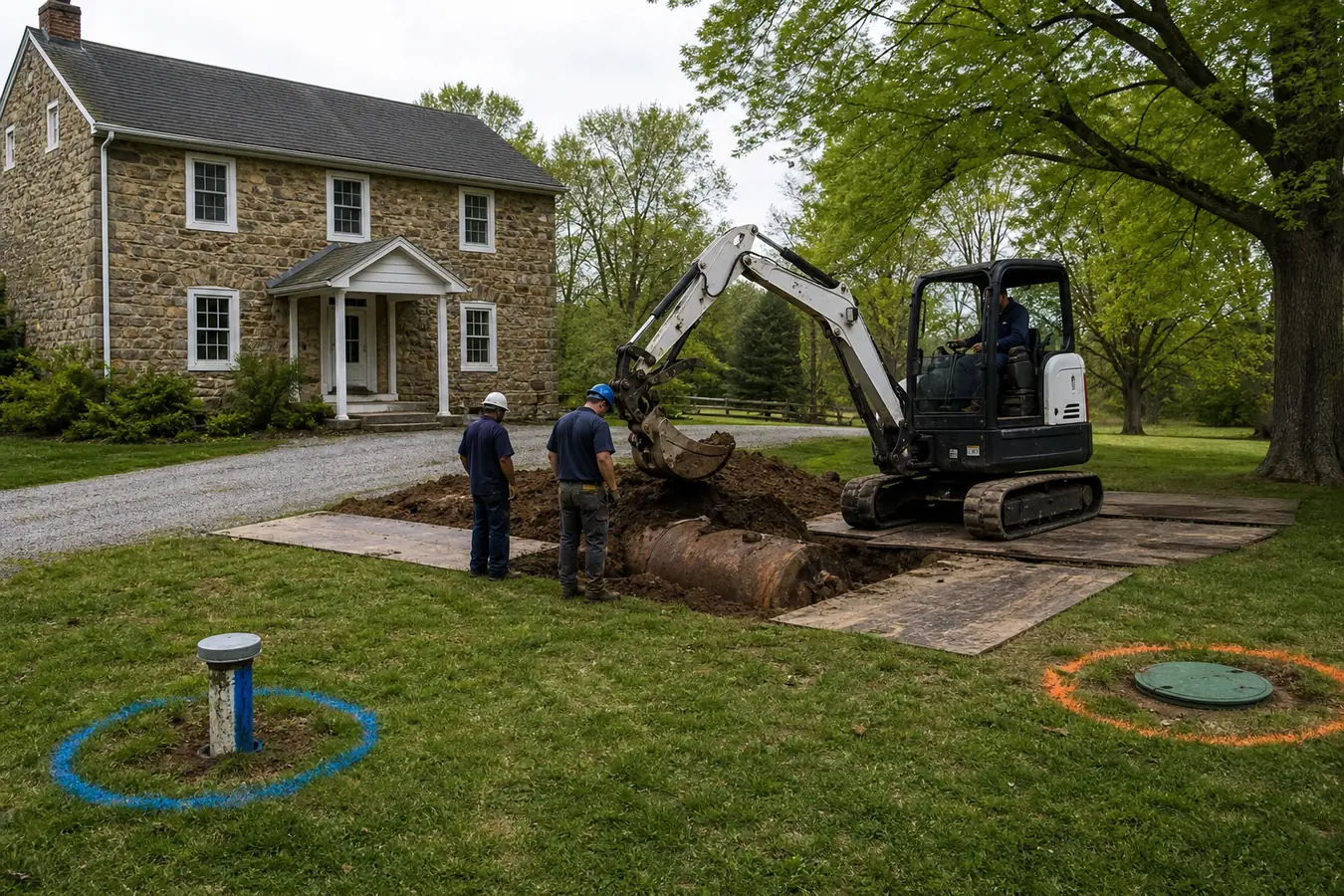
Chester County is the one county around Philadelphia where the question after a tank removal is not only what is in the soil. On a large share of properties here the household drinks from its own well, and the well is in the same ground as the tank.
That reorders the priorities. On a rowhouse the soil result is a property record. On a well-served farmhouse it is a drinking water question, and it is the reason sampling is never the line to cut from a Chester County quote.
Covered in Chester County
- West Chester
- Phoenixville
- Coatesville
- Kennett Square
- Downingtown
- Malvern
- Exton
- Oxford
- Parkesburg
- Spring City
- Honey Brook
- Avondale
These are the places named on this page. The whole of Chester County is covered, whether or not it appears here.
Where The Water Comes From Changes The Job
An estimated 26% of Pennsylvania's adults rely on private well water as their main drinking water source, and Chester County's rural townships are firmly in that share. Where a property is on a private well, there is no utility monitoring what comes out of the tap.
Heating oil that reaches the ground near a well head is therefore a different order of problem from the same release in a paved suburban yard. It is the one situation in this trade where the honest advice is to stop guessing and sample early, before an excavation is backfilled and the evidence is buried under clean fill.
Most properties on well water are also on on-lot septic, which puts a second buried system in the same ground. Knowing where the septic tank, the distribution box and the drain field sit before an excavator arrives avoids turning a tank removal into a septic repair.
PA Department of Health, private well water (2020 data, checked Aug 2026)
Farmhouses, Long Drives And Tanks Placed For The Truck
Chester County's older rural stock was heated by whatever could be delivered, and the tank went where a truck could reach it rather than where it would be convenient to dig up seventy years later. On a farmhouse that can mean a large tank well away from the building, sometimes more than one, and sometimes one that was replaced rather than removed when the first failed.
Above-ground tanks are more common here than in the inner suburbs, standing against an outbuilding or on a stand beside the house. They are the easiest to remove and the easiest to overlook, because the ground beneath a tank that has been weeping at a fitting for a decade is soil that has never been looked at.
Long unmade driveways are their own constraint. Getting a machine and a haulage truck to a tank several hundred feet from the road, across ground that has to be left usable, is part of the job rather than an afterthought.
Rural properties are also where buried services are least well recorded, which makes the Pennsylvania One Call notice worth more than the three to ten business days it costs. What that involves is on the underground removal page.
PA One Call, Act 287 of 1974 as amended (checked Aug 2026)
The Borough Cores Are A Different County Entirely
West Chester, Phoenixville, Coatesville, Downingtown, Kennett Square and Oxford have compact older cores that behave nothing like the surrounding townships. Narrow lots, party walls, basements in use, public water and sewer, and tanks that are as likely to be in a basement as in the ground.
Work in those boroughs looks much more like Delaware County rowhouse work than like a farm at the western end of the county, and it should be quoted that way.
Permits In A County Of Rural Townships
Chester County does not issue building permits. Under the Pennsylvania Uniform Construction Code the municipality does, and over 90% of Pennsylvania's 2,562 municipalities have elected to enforce the code locally.
The wrinkle in a largely rural county is availability rather than complexity. A small township may run its code office limited hours, and where a municipality has opted out of enforcing the code, residential work is handled by a certified third-party agency engaged by the owner or contractor, with the Department of Labor and Industry taking commercial work.
That affects timing more than cost, and it is worth knowing about early if the removal is tied to a settlement date.
PA Uniform Construction Code, municipal enforcement (checked Aug 2026)34 Pa. Code section 403.102, municipal election (checked Aug 2026)
The Commonwealth Rules Do Not Change Out Here
A confirmed release must be reported to the appropriate DEP regional office as soon as practicable and no later than 24 hours after it is confirmed, under 25 Pa. Code section 245.305. Distance from the city makes no difference to that: the western end of Chester County reports to the same Southeast Regional Office in Norristown, on 484-250-5900, as a rowhouse in the city.
Nor does it change the reimbursement. For underground heating oil tanks of 3,000 gallons or less, eligible cleanup costs above a $1,000 deductible are reimbursable up to a maximum of $4,000, set out in full on the reimbursement page.
25 Pa. Code section 245.305, reporting releases (checked Aug 2026)PA DEP Southeast Regional Office (checked Aug 2026)PA DEP heating oil tank cleanup reimbursement (checked Aug 2026)
Everywhere Else We Cover
Find your neighborhood A to Z- Northeast PhiladelphiaWhere the build decade tells you the odds before anyone looks
- Northwest PhiladelphiaStone houses on large lots, where reinstatement outweighs removal
- Roxborough and ManayunkThe one district where the constraint is gradient
- South PhiladelphiaThe densest stock in the city, and the carry-out goes through the house
- West PhiladelphiaVictorian twins with deep rear yards, the easiest digging in the old city
- The River WardsSmall 19th century rows on ground that used to hold industry
- Delaware CountyRowhouse and twin stock, and forty-nine separate permit offices
- Montgomery CountyThe widest spread of tank sizes in the region, from 275 to 1,000 gallons
- Bucks CountyLevittown slab houses and the river boroughs, two different tank problems
Common Questions
- We are on a private well. Should we test the water?
- If there is any sign a tank has leaked, yes, and early. An estimated 26% of Pennsylvania adults rely on private wells as their main drinking water source, and nobody monitors a private well but its owner. Testing before an excavation is backfilled is far more useful than testing after.
- Will you hit our septic system?
- Not if we know where it is. Establishing the position of the septic tank, distribution box and drain field is part of the survey on any property that is not on public sewer, precisely so the excavation does not go through it.
- There may be more than one tank on the property. Is that common?
- On older rural properties it is not unusual. A failed tank was sometimes abandoned and a replacement installed elsewhere rather than the original being removed. A sweep of the plausible ground is the way to establish what is actually there.
- Who issues the permit for a rural Chester County township?
- The township itself, under the Pennsylvania Uniform Construction Code, or a certified third-party agency where the township has opted out of enforcing the code. The county does not issue building permits.
A Written Quote In Chester County
Tell us the address and whether the property is on a private well and on-lot septic. Both change what we sample and where we can safely dig, so it is worth saying at the start.
Where This Came From
Every fee, rule and figure on this page came from one of the following, each checked on the date shown. Full citations and links are on the sources page.
- Pennsylvania Department of Health, Well Water (2020 data, checked Aug 2026)
- Pennsylvania One Call System, Excavator FAQs (Act 287 of 1974 as amended, 73 P.S. section 176 et seq.) (checked Aug 2026)
- Pennsylvania Department of Labor and Industry, Uniform Construction Code (checked Aug 2026)
- 34 Pa. Code Chapter 403, section 403.102 (Municipalities electing to enforce the Uniform Construction Code) (checked Aug 2026)
- 25 Pa. Code Chapter 245, section 245.305 (Reporting releases) (checked Aug 2026)
- Pennsylvania Department of Environmental Protection, Southeast Regional Office (checked Aug 2026)
- Pennsylvania Department of Environmental Protection, Apply for Underground Oil Tank Cleanup Reimbursement (checked Aug 2026)