Oil Tank Removal in Northwest Philadelphia
Northwest Philadelphia has the oldest and largest housing stock in the city. Stone twins, Victorian detached houses and nineteenth century farmhouses on lots measured in fractions of an acre rather than in feet of frontage.
Large houses were heated by large tanks, and large grounds meant the tank went where the delivery truck could reach it. Both facts push this district away from the rest of the city, and they push it in the same direction: the removal is rarely the expensive part.
- Typical build era
- Nineteenth century into the 1930s
- Where the tank usually is
- Well away from the house, sized for it
- What usually decides the price
- Putting the grounds back
Big Houses Took Big Tanks
The 275 gallon tank that is standard across most of Philadelphia was often not enough here. A large stone house with multiple floors and single glazing burned through capacity, so 550 gallon tanks are common in the district and 1,000 gallon tanks are not unusual on the Chestnut Hill end.
Capacity changes the whole job. It sets the size of the excavation, the machine needed to lift the tank, the volume of residual product to be pumped and manifested, and, if the tank failed, the ceiling on how much oil could have entered the ground.
It does not change the funding position. The Pennsylvania reimbursement covers underground heating oil tanks of 3,000 gallons or less, so even a 1,000 gallon tank sits comfortably inside it, as the reimbursement page sets out.
PA DEP heating oil tank cleanup reimbursement (checked Aug 2026)
Finding It Is Half The Work
On a narrow rowhouse lot the tank is in one of about three places. On a half acre in Mount Airy it could be almost anywhere, and it will be wherever an oil truck could get to in 1935 rather than wherever is convenient now.
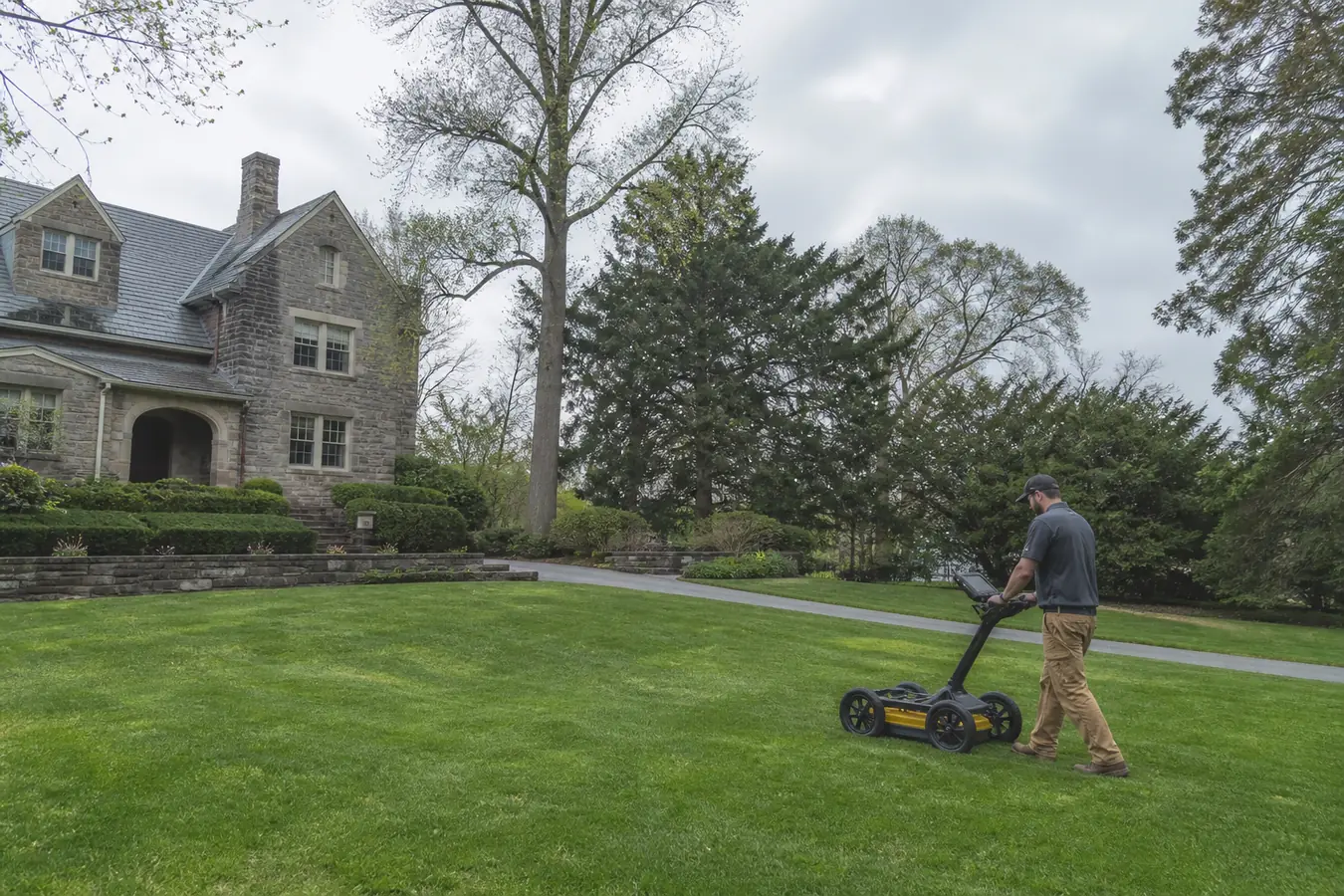
A century of planting, terracing and repaving hides the evidence. A capped fill pipe against a garden wall, a vent stub in a shrub bed or a suspiciously flat patch of lawn is often all that is left, and none of it is proof. This is the district where a ground penetrating radar sweep genuinely earns its cost, because the alternative is opening the wrong part of an expensive garden.
The Reinstatement Is The Real Number
Mature planting, stone paving, terraces, established lawn and old boundary walls are expensive to take up and expensive to put back, and unlike a concrete driveway apron they cannot simply be repoured.
That means the quote for a Northwest removal is weighted differently from anywhere else in the city. The excavation and the tank are a smaller share of it, and what happens to the ground afterwards is a larger one. What gets restored, to what standard, and by whom, is worth agreeing in writing before the work starts rather than discovering afterwards.
Where a property sits in a historic district, that conversation starts earlier still, because the finish is not entirely the owner's choice.
Neighborhoods in Northwest Philadelphia
- Germantown
- Mount Airy
- West Mount Airy
- East Mount Airy
- Chestnut Hill
- East Falls
- Wissahickon
- Nicetown
- Logan
The permit, the fees and the contractor licensing are the same at every address in Philadelphia. They are set out once on the permit page rather than repeated here.
Everywhere Else We Cover
Find your neighborhood A to Z- Northeast PhiladelphiaWhere the build decade tells you the odds before anyone looks
- Roxborough and ManayunkThe one district where the constraint is gradient
- South PhiladelphiaThe densest stock in the city, and the carry-out goes through the house
- West PhiladelphiaVictorian twins with deep rear yards, the easiest digging in the old city
- The River WardsSmall 19th century rows on ground that used to hold industry
- Delaware CountyRowhouse and twin stock, and forty-nine separate permit offices
- Montgomery CountyThe widest spread of tank sizes in the region, from 275 to 1,000 gallons
- Bucks CountyLevittown slab houses and the river boroughs, two different tank problems
- Chester CountyPrivate wells and on-lot septic, which changes what a leak means
Common Questions
- How big are the tanks in Chestnut Hill and Mount Airy?
- Larger than the city norm. The 275 gallon tank standard elsewhere is often a 550 in this district, and 1,000 gallon tanks appear on the larger properties, because the houses needed the capacity.
- We have no idea where the tank is on our lot. Where do you start?
- With a survey of the plausible ground rather than a guess. Ground penetrating radar reads the shape of what is buried, and on a large lot it is far cheaper than opening a lawn or a terrace in the wrong place.
- Will you damage the garden?
- Excavation means opening the ground, so the honest answer is that something has to come up. What matters is agreeing in advance exactly what is lifted and how it is put back, because on these properties the reinstatement is usually the larger part of the cost.
- Does a 1,000 gallon tank still qualify for the state reimbursement?
- Yes. The Pennsylvania DEP program covers underground heating oil tanks of 3,000 gallons or less, so every ordinary residential tank in the district is inside the threshold.
A Written Quote In Northwest Philadelphia
Give us the address and anything you know about where the tank might be. On a large lot, locating it is the first job and the reinstatement is the one worth talking through before we quote.
Where This Came From
Every fee, rule and figure on this page came from one of the following, each checked on the date shown. Full citations and links are on the sources page.
- Pennsylvania Department of Environmental Protection, Apply for Underground Oil Tank Cleanup Reimbursement (checked Aug 2026)