Oil Tank Removal in Montgomery County, PA
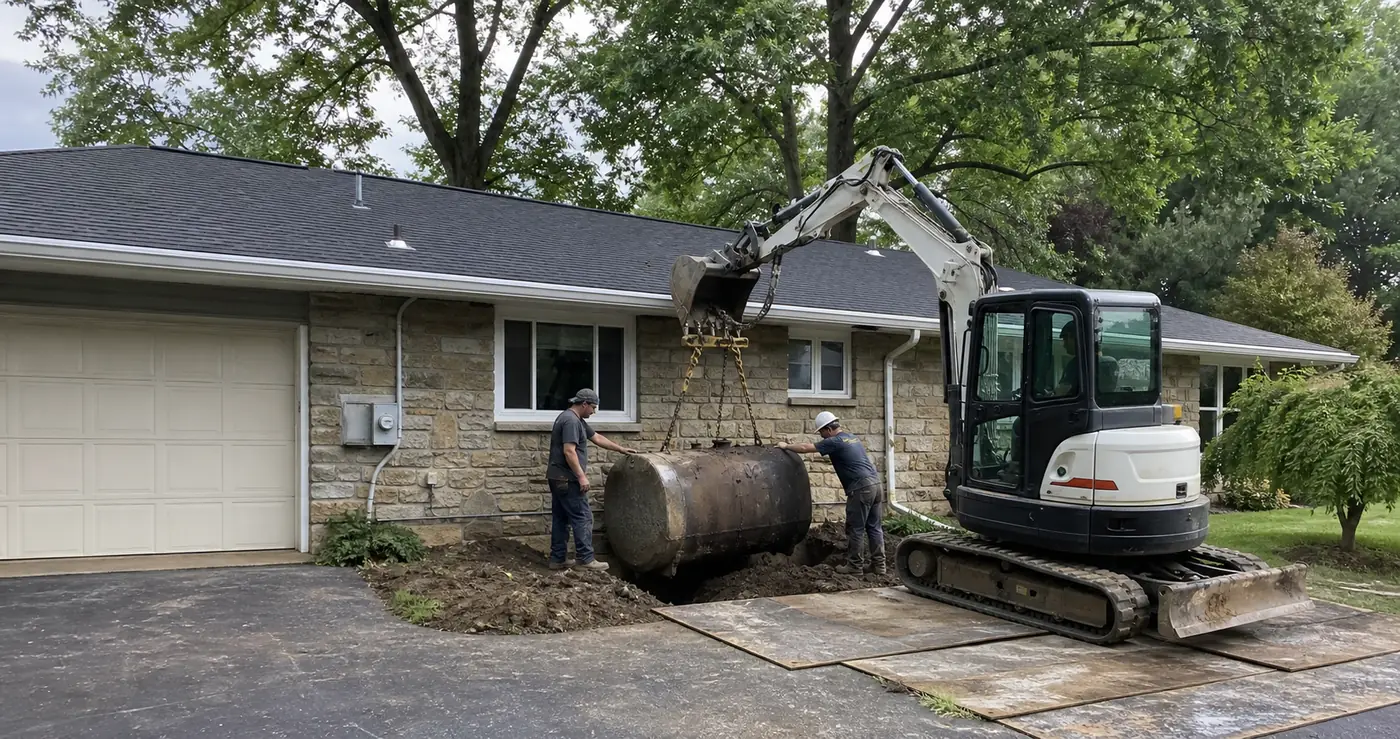
Montgomery County holds the widest range of property types of any county around Philadelphia, and tanks were sized to the house. That makes size the variable that matters most here, because it drives the excavation, the disposal, the volume of product to be pumped and the extent of any contamination.
A 275 gallon tank behind a Norristown row and a 1,000 gallon tank under a Lower Merion driveway are the same service and very different jobs.
Covered in Montgomery County
- Lower Merion
- Ardmore
- Bala Cynwyd
- Cheltenham
- Abington
- Jenkintown
- Norristown
- Conshohocken
- Ambler
- Lansdale
- Pottstown
- Willow Grove
These are the places named on this page. The whole of Montgomery County is covered, whether or not it appears here.
Four Different Tank Populations In One County
The Main Line end, Lower Merion and the villages through Bala Cynwyd, Narberth, Ardmore and Wynnewood, has the largest houses in the region outside the city. Large houses were heated by large tanks, frequently 550 or 1,000 gallons, and often buried well away from the building under what is now lawn or a paved drive.
The inner-ring townships and boroughs, Cheltenham, Abington, Jenkintown and Glenside, are denser and closer to Philadelphia in character. Smaller lots, more basements in use, more 275 gallon tanks, and access constraints closer to the city pattern.
The older borough cores, Norristown, Pottstown, Conshohocken, Ambler and Lansdale, have compact nineteenth and early twentieth century stock: narrow lots, party walls, and tanks in basements as often as in the ground. The western and northern townships are largely newer and gas from the start, which is why a tank there is more likely to be a genuine surprise.
Tank Size Drives Everything Else
Capacity sets the size of the hole, which sets the machine, which sets the access requirement. It sets how much product has to be pumped and manifested for disposal. And if the tank leaked, it sets the ceiling on how much oil could have entered the ground.
It also decides which Pennsylvania fund you are dealing with, and this is where Montgomery County owners get caught more often than most, because the county genuinely does have larger residential tanks. The DEP reimbursement program applies to underground heating oil tanks of 3,000 gallons or less. The separate USTIF voluntary heating oil program applies to nonregulated underground heating oil tanks of 3,000 gallons or greater.
Every ordinary residential tank, up to and including a 1,000 gallon Main Line tank, sits comfortably inside the DEP program. The reimbursement guide explains why the two funds get confused and which numbers belong to which.
PA DEP heating oil tank cleanup reimbursement (checked Aug 2026)PA Underground Storage Tank Indemnification Fund, heating oil tanks (checked Aug 2026)
The Permit Is A Township Or Borough Matter
Montgomery County does not issue building permits. Under the Pennsylvania Uniform Construction Code the municipality does, and the county is divided into more than sixty of them, split between townships and boroughs that run their code offices quite differently from one another.
The practical difference in Montgomery County is scale rather than number. A large township runs a full-time code department with published procedures. A small borough may not, and where a municipality has opted out of enforcing the code, residential work is handled by a certified third-party agency hired by the owner or contractor instead.
Either way the requirement is the same: the tank work is permitted work, and the sign-off at the end is the document worth having when the property is sold.
The Commonwealth layer above it does not fragment at all. Montgomery County sits in DEP's Southeast Region, so a confirmed release anywhere in the county is reported to the Southeast Regional Office in Norristown on 484-250-5900, inside the 24 hours that 25 Pa. Code section 245.305 allows.
PA Uniform Construction Code, municipal enforcement (checked Aug 2026)34 Pa. Code section 403.102, municipal election (checked Aug 2026)PA DEP Southeast Regional Office (checked Aug 2026)25 Pa. Code section 245.305, reporting releases (checked Aug 2026)
Large Tanks And Large Grounds
On the bigger Main Line and northern properties, the tank is often nowhere near the house. It was placed where the delivery truck could reach it, which after seventy years of planting and paving can be under a lawn, a terrace or a driveway turning circle with no visible trace beyond a capped pipe.
That makes locating the first job rather than an afterthought, and it is why an oil tank sweep earns its cost on a large lot in a way it does not on a twenty foot rowhouse yard.
It also makes reinstatement a bigger share of the price than the removal. Mature planting, stone, and long paved drives are expensive to put back, and what gets restored to what standard belongs in the quote before the work starts.
Everywhere Else We Cover
Find your neighborhood A to Z- Northeast PhiladelphiaWhere the build decade tells you the odds before anyone looks
- Northwest PhiladelphiaStone houses on large lots, where reinstatement outweighs removal
- Roxborough and ManayunkThe one district where the constraint is gradient
- South PhiladelphiaThe densest stock in the city, and the carry-out goes through the house
- West PhiladelphiaVictorian twins with deep rear yards, the easiest digging in the old city
- The River WardsSmall 19th century rows on ground that used to hold industry
- Delaware CountyRowhouse and twin stock, and forty-nine separate permit offices
- Bucks CountyLevittown slab houses and the river boroughs, two different tank problems
- Chester CountyPrivate wells and on-lot septic, which changes what a leak means
Common Questions
- How big are Montgomery County heating oil tanks?
- There is no single answer, which is the point. Denser boroughs and the inner-ring townships are mostly 275 gallon tanks. Larger Main Line and northern township properties frequently ran 550 or 1,000 gallon tanks because the house needed the capacity.
- Does a bigger tank mean a bigger reimbursement?
- No. The Pennsylvania DEP program reimburses eligible cleanup costs above a $1,000 deductible up to a maximum of $4,000, and the ceiling does not scale with tank size. What size affects is eligibility at the top end: the program covers underground heating oil tanks of 3,000 gallons or less.
- Who issues the permit in Montgomery County?
- The township or borough, not the county. Montgomery County has more than sixty municipalities and they administer the Uniform Construction Code themselves, or in an opted-out municipality through a certified third-party agency for residential work.
- The tank is somewhere in a large garden and we do not know where. What now?
- Locating comes before quoting. A ground penetrating radar sweep of the plausible area establishes whether a tank is there and where, which is a great deal cheaper than opening the wrong part of a lawn.
A Written Quote In Montgomery County
Give us the address and the tank size if you know it. Where you do not, that is fine, and establishing it is part of the survey, because size sets the excavation, the disposal and the reinstatement.
Where This Came From
Every fee, rule and figure on this page came from one of the following, each checked on the date shown. Full citations and links are on the sources page.
- Pennsylvania Department of Environmental Protection, Apply for Underground Oil Tank Cleanup Reimbursement (checked Aug 2026)
- Pennsylvania Insurance Department, Underground Storage Tank Indemnification Fund, Heating Oil Tanks (checked Aug 2026)
- Pennsylvania Department of Labor and Industry, Uniform Construction Code (checked Aug 2026)
- 34 Pa. Code Chapter 403, section 403.102 (Municipalities electing to enforce the Uniform Construction Code) (checked Aug 2026)
- Pennsylvania Department of Environmental Protection, Southeast Regional Office (checked Aug 2026)
- 25 Pa. Code Chapter 245, section 245.305 (Reporting releases) (checked Aug 2026)