Selling A Philadelphia House With An Oil Tank
For a buyer, a tank is a risk to price. For a seller it is a disclosure obligation with a statute behind it, and that changes what the sensible move is.
Pennsylvania requires you to hand the buyer a completed property disclosure statement before the agreement of sale is signed. The approved form asks about underground tanks in two separate places. There is no version of selling a Philadelphia house where the question does not come up.
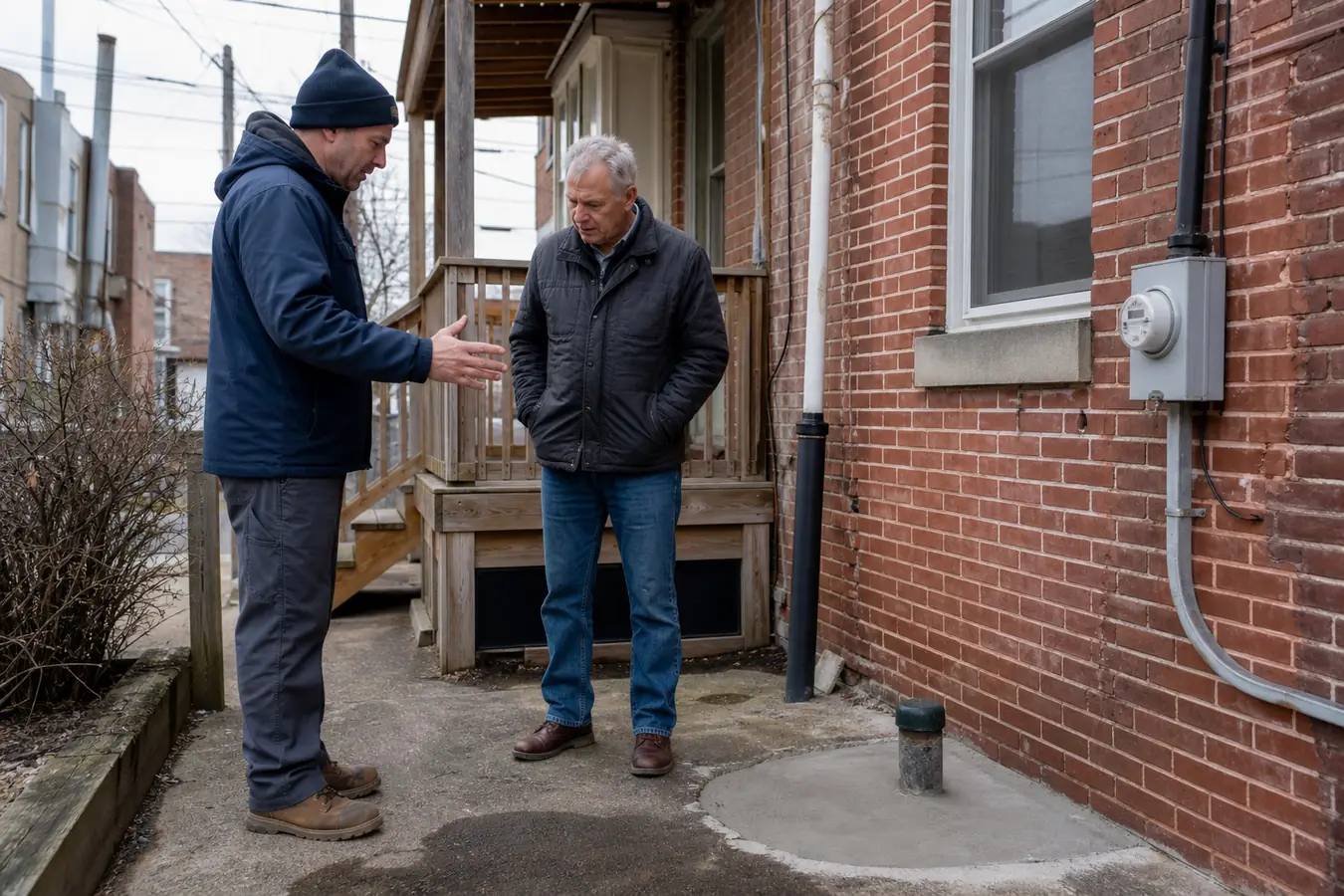
The Form Asks About Tanks Twice
The seller property disclosure statement is set by regulation, at 49 Pa. Code section 35.335a, and it runs to seventeen categories. Two of them reach a heating oil tank.
Under Hazardous Substances, item 14, the form asks: "Are you aware of any underground tanks or hazardous substances present on the property (structure or soil), including, but not limited to, asbestos, polychlorinated byphenyls (PCBs), radon, lead paint, urea-formaldehyde foam insulation (UFFI), etc?" Under Heating and Air Conditioning, item 10, it asks separately: "Are you aware of any underground fuel tanks on the property?"
The same subject, asked twice, in two different sections, by a form the State Real Estate Commission approves. That is not an area where a seller can reasonably claim the question was ambiguous.
49 Pa. Code section 35.335a, seller property disclosure statement (checked Aug 2026)
What The Statute Actually Requires
Under 68 Pa.C.S. section 7303, a seller intending to transfer an interest in real property must disclose known material defects by completing all applicable items in a property disclosure statement, and a signed and dated copy has to be delivered to the buyer prior to the signing of an agreement of transfer. Not at closing. Before the contract.
Section 7308 is the part sellers are usually relieved to read: "The seller is not obligated by this chapter to make any specific investigation or inquiry in an effort to complete the property disclosure statement." You do not have to commission a tank sweep before listing. What you may not do is make a representation you know or have reason to know is false or misleading, or conceal a known material defect.
Section 7311 is the part that matters afterwards. A person who willfully or negligently violates a duty under the chapter is liable for the actual damages the buyer suffers, and an action must be commenced within two years after the date of final settlement. The tank does not stop being your problem when you hand over the keys; it stops being your problem two years later.
68 Pa.C.S. Chapter 73, Real Estate Seller Disclosure Law (checked Aug 2026)
Answering When You Genuinely Do Not Know
Plenty of Philadelphia sellers inherited a house, or bought it in 1998 from someone who told them nothing. The honest answer to both questions is that you do not know, and the honest answer is the correct one to give.
What that answer does, though, is transfer the question rather than close it. A disclosure saying the seller is unaware of any underground tank on a 1930s rowhouse with a capped pipe on the side wall invites the buyer's inspector to look, and a finding at that point lands mid-deal with the buyer holding the timeline.
This is the practical case for finding out before you list rather than during. Not because the statute requires it, because it does not, but because information you commissioned is information you control the timing of. The tank sweep page covers what that involves.
68 Pa.C.S. Chapter 73, Real Estate Seller Disclosure Law (checked Aug 2026)
Removing Before Listing Against Crediting At Closing
Removing before you list costs money at the worst time and takes the issue off the table entirely. You get the City permit and the Certificate of Approval, the soil result and the disposal records, and the disclosure answer becomes a documented yes with paperwork attached rather than an open question.
Crediting the buyer keeps cash in your pocket now and hands them a discount plus a problem. The difficulty is that a credit is negotiated under time pressure by someone who has just been told there may be contaminated soil, and buyers price uncertainty conservatively. A credit is almost always larger than the removal would have been.
There is also a third outcome nobody plans for, where the buyer's lender declines the property outright. That is not a negotiation, it is the deal ending, and it happens more often with a tank abandoned in place with no documentation than with any other version of this. The abandonment page covers why.
City of Philadelphia L&I, hazardous material tank permit (checked Aug 2026)
What A Documented Removal Is Actually Worth At Sale
Three documents do the work: the City permit with its Certificate of Approval, the laboratory result for the soil taken from under the tank, and the disposal records for the tank and its contents.
The soil result is the one that carries the value. A removal with no sampling proves a tank is gone and proves nothing about what it left behind, which means the buyer's attorney is still asking questions. A clean laboratory result ends the conversation, and it stays with the property for the next sale too.
If the tank did leak, the position is better than most sellers expect. Cleanup is a defined process rather than an open-ended liability, and eligible costs above a $1,000 deductible are reimbursable up to $4,000 for tanks of 3,000 gallons or less, set out on the reimbursement page.
City of Philadelphia L&I, hazardous material tank permit (checked Aug 2026)PA DEP heating oil tank cleanup reimbursement (checked Aug 2026)
Selling As Is Does Not Remove The Duty
An as-is sale allocates the cost of repairs. It does not repeal Chapter 73. The disclosure statement is still required, the questions still have to be answered, and section 7311 still runs for two years after settlement.
A seller who knows there is a tank, marks the property as-is and answers no is in a materially worse position than a seller who discloses the tank and sells as-is anyway. The second one has a buyer who knew. The first has a buyer with a statute.
68 Pa.C.S. Chapter 73, Real Estate Seller Disclosure Law (checked Aug 2026)
Related
- Buying A House With A TankWhat to settle before closing, and who ends up paying for it
- Abandonment In PlaceWhen filling is allowed, and what a lender does with it afterwards
- What It CostsEvery line that moves the number, and the ones nobody quotes for
- Underground Tank RemovalExcavated, inspected in the open hole, hauled and documented
Common Questions
- Do I have to disclose an oil tank when selling in Pennsylvania?
- You have to answer the questions on the seller property disclosure statement truthfully about what you know. The approved form asks about underground tanks in two places, at item 14 under hazardous substances and item 10 under heating, and a signed copy has to reach the buyer before the agreement of transfer is signed.
- Do I have to look for a tank before I sell?
- No. 68 Pa.C.S. section 7308 says the seller is not obligated to make any specific investigation or inquiry to complete the disclosure statement. You cannot conceal what you do know, but the statute does not require you to go and find out.
- How long can a buyer come after me about it?
- An action for damages under the seller disclosure chapter must be commenced within two years after the date of final settlement, and liability is for the actual damages the buyer suffers where the violation was willful or negligent.
- Is it cheaper to remove the tank or give the buyer a credit?
- A credit is usually the larger number in the end. It is negotiated under deadline pressure by a buyer pricing an unknown, whereas a removal you commission before listing is priced as ordinary work and comes with documentation that closes the question.
- Can I just sell the house as is?
- You can sell as is, but that allocates repair costs; it does not remove the disclosure duty. The statement is still required and the two year exposure after settlement still applies.
- The tank was filled with sand before I owned the house. What do I say?
- Disclose what you know, including that you do not know whether it was cleaned, sampled or documented. An undocumented fill is the version most likely to stall a sale, so it is worth establishing the position early rather than at the inspection.
A Written Quote For Your Property
You do not need technical details. The address and where you think the tank sits are enough to start a useful conversation about access, permits and the likely method.
Where This Came From
Every fee, rule and figure on this page came from one of the following, each checked on the date shown. Full citations and links are on the sources page.
- 49 Pa. Code Chapter 35, section 35.335a (Seller property disclosure statement) (checked Aug 2026)
- 68 Pa.C.S. Chapter 73 (Seller Disclosures), sections 7303, 7308 and 7311 (checked Aug 2026)
- City of Philadelphia, Get a building permit for a tank to store hazardous materials (checked Aug 2026)
- Pennsylvania Department of Environmental Protection, Apply for Underground Oil Tank Cleanup Reimbursement (checked Aug 2026)