Oil Tank Removal in Roxborough and Manayunk
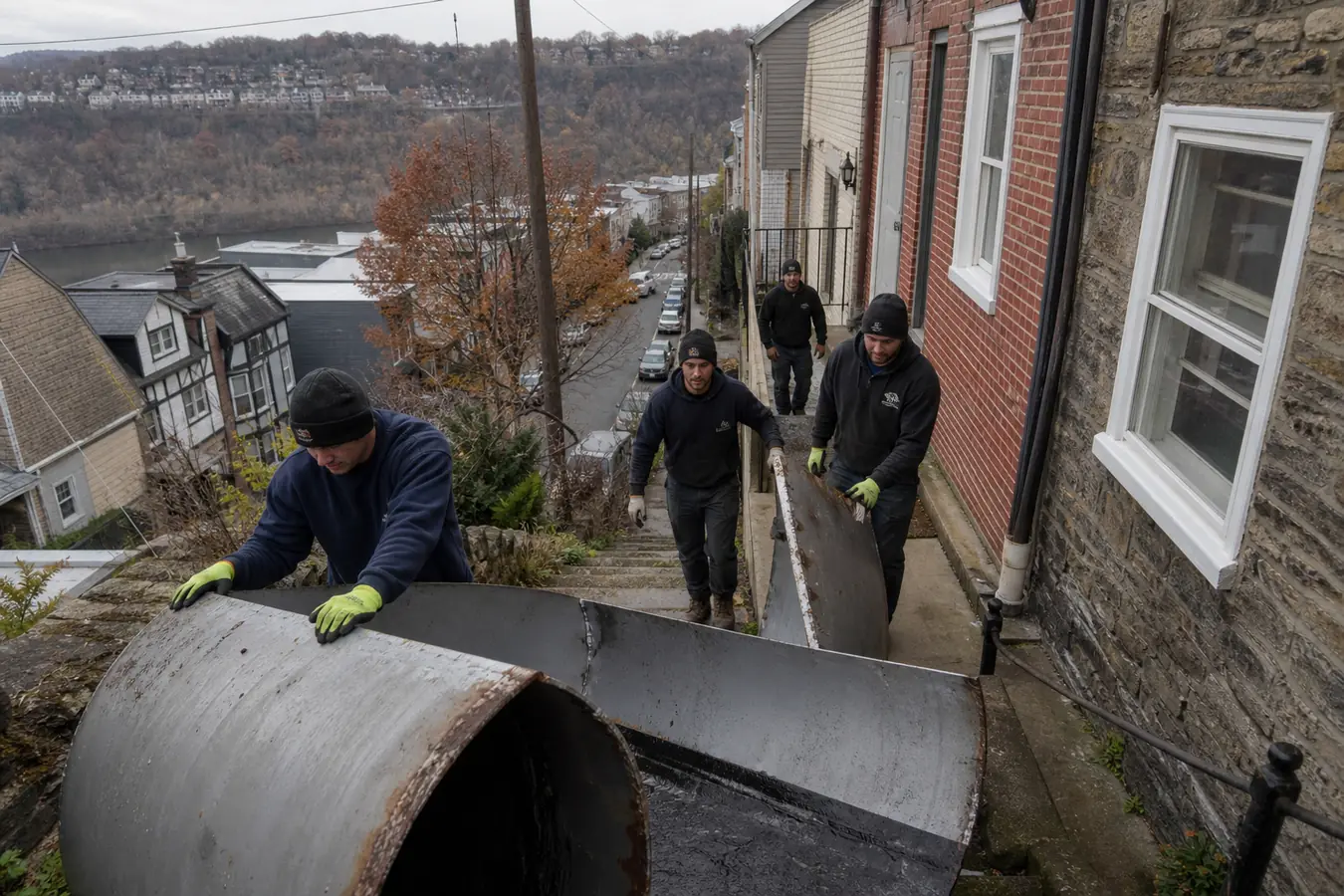
Everywhere else in Philadelphia the question is how to get past the house. Here it is how to get up the hill.
The Schuylkill has cut a steep, narrow canyon roughly 300 feet deep through this part of the city. Manayunk occupies the strip between the river and the ridge, the ground rises sharply from Main Street toward Ridge Avenue, and Roxborough sits on top at elevations reaching about 420 feet. The housing was built into that slope, and so was the tank.
- The defining constraint
- Streets climbing a 300 foot river canyon
- Where the tank usually is
- In a cut, a terrace or a small level yard
- What usually decides the price
- Whether a machine can reach it at all
What A Gradient Does To The Job
A tracked excavator has a working limit on a slope, and a great many properties on these streets exceed it. Where the ground in front of or behind a house is a bank rather than a yard, the machine either cannot get there or cannot safely work once it does, and the excavation becomes a hand dig.
The streets themselves are the second constraint. Blocks that climb sharply give a haulage truck nowhere level to stand, and some of the connections between streets here are public stairs rather than roads, which means no vehicle route at all. Where a tank has to be carried out to a truck parked on the flat, the distance and the gradient are the job.
Retaining walls and terracing are the third. Excavating beside or below a retaining structure is a different exercise from digging in open ground, and it has to be planned rather than discovered, particularly where the wall is holding up a neighbor's ground.
Encyclopedia of Greater Philadelphia, Topography (checked Aug 2026)
Where The Tank Ends Up On A Slope
On sloping ground the tank went wherever there was something level, which is usually a cut behind the house, a terrace, or the small flat apron between the building and the street. On the steeper Manayunk blocks that can mean the tank sits above or below the level of the house rather than beside it.
That is worth knowing before booking anything, because on a hillside the shortest route to a tank is often not the usable one. Establishing the position and the levels together is what the survey is for.
Older Stock, Smaller Yards, Full Basements
The rows built densely up these hillsides are older and tighter than the Northeast, with full basements in use and yards measured in feet. A good share of tanks here were never buried at all: they stood in the basement, which turns the job into a cut and carry rather than an excavation.
A basement tank is the better outcome on a gradient, because the hill stops being relevant the moment nothing has to be dug. The stair still has to be negotiated, but a stair is a known quantity in a way a bank is not.
Neighborhoods in Roxborough and Manayunk
- Manayunk
- Roxborough
- Wissahickon
- East Falls
- Andorra
- Upper Roxborough
The permit, the fees and the contractor licensing are the same at every address in Philadelphia. They are set out once on the permit page rather than repeated here.
Everywhere Else We Cover
Find your neighborhood A to Z- Northeast PhiladelphiaWhere the build decade tells you the odds before anyone looks
- Northwest PhiladelphiaStone houses on large lots, where reinstatement outweighs removal
- South PhiladelphiaThe densest stock in the city, and the carry-out goes through the house
- West PhiladelphiaVictorian twins with deep rear yards, the easiest digging in the old city
- The River WardsSmall 19th century rows on ground that used to hold industry
- Delaware CountyRowhouse and twin stock, and forty-nine separate permit offices
- Montgomery CountyThe widest spread of tank sizes in the region, from 275 to 1,000 gallons
- Bucks CountyLevittown slab houses and the river boroughs, two different tank problems
- Chester CountyPrivate wells and on-lot septic, which changes what a leak means
Common Questions
- Our street is too steep for a truck. Can the tank still come out?
- Yes, but the method changes. Where there is no level standing for a vehicle, the tank is cut into sections after cleaning and carried to wherever the truck can legally stand. The distance and the gradient are what set the cost rather than the tank itself.
- Why is a Manayunk quote higher than one across the river?
- Almost always access. A property a machine can reach on the flat and a property that has to be worked by hand up a bank are different amounts of labour for an identical tank, and that gap is wider here than anywhere else in the city.
- There is a retaining wall next to where the tank is. Is that a problem?
- It is a planning question rather than a stopper. Excavating beside or below a retaining structure needs the working method set out in advance, especially where the wall supports a neighbouring property.
- Is a basement tank easier here?
- Considerably. Once nothing has to be excavated, the gradient stops mattering, and a basement tank is drained, cleaned, cut down and carried out the same way it would be anywhere else in the city.
A Written Quote In Roxborough and Manayunk
Give us the address and tell us what the ground does. Whether a machine can stand anywhere useful, and how far it is to the nearest level parking, decides this job more than the tank does.
Where This Came From
Every fee, rule and figure on this page came from one of the following, each checked on the date shown. Full citations and links are on the sources page.
- Encyclopedia of Greater Philadelphia (Rutgers-Camden), Topography (checked Aug 2026)