Oil Tank Abandonment In Place
Abandonment in place means the tank stays in the ground. It is pumped out, cleaned, cut open, inspected and filled with an inert material so it cannot collapse or hold product, and the soil around it is sampled to establish whether it leaked before it was closed.
Done properly and documented, it is a legitimate closure. Done as a shortcut, it is the single most common reason a Philadelphia sale stalls twenty years later.
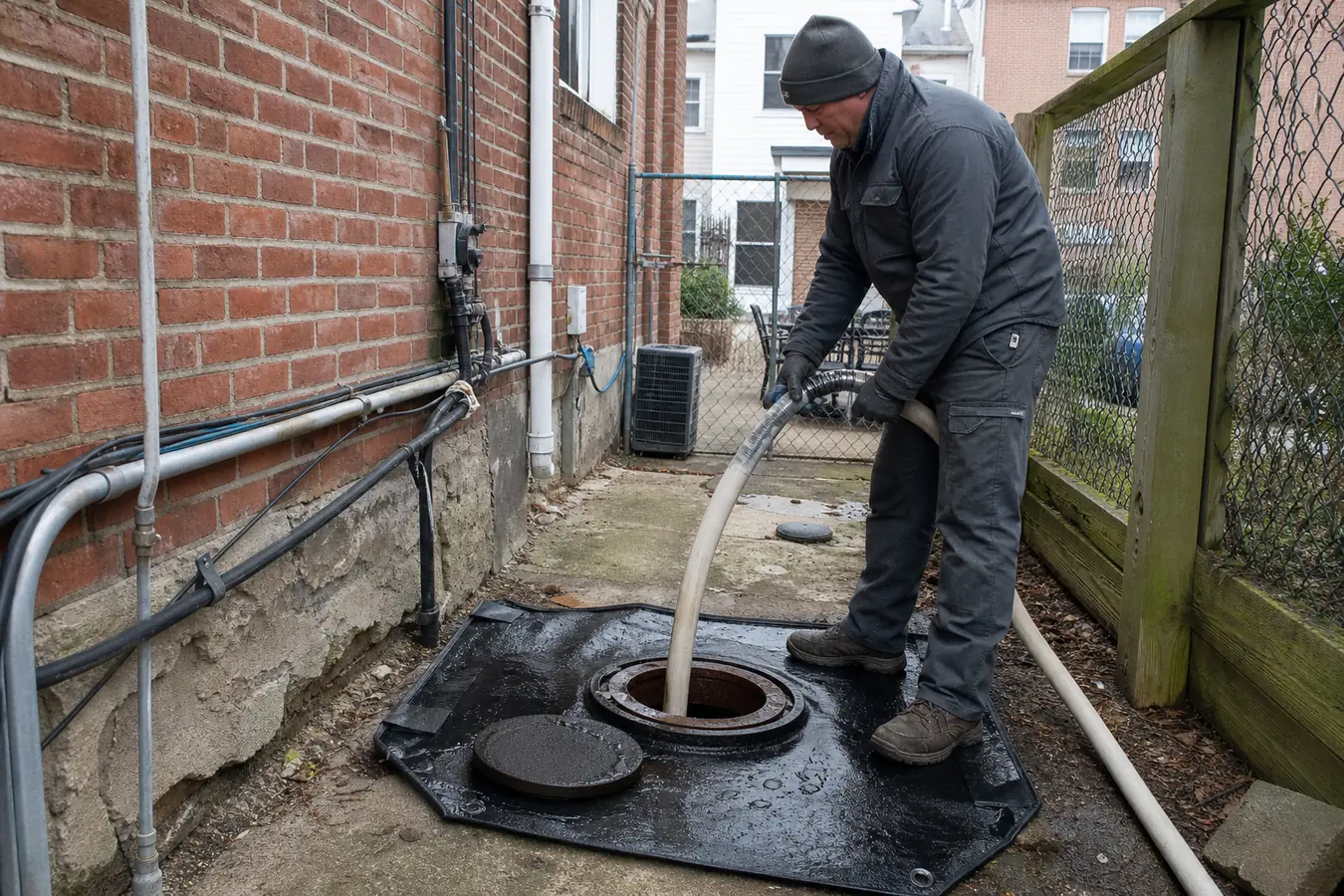
When Filling Is The Right Call
The case for leaving a tank where it is comes down to what removing it would destroy. A tank sitting under a load-bearing footing, beneath a finished basement slab, under a structure that would have to come down, or in a rear yard with no access route wider than a person, is a tank where excavation costs more in reinstatement than the removal is worth.
It is a judgement about that specific property, not a general preference. On an open Philadelphia yard with rear access, removal is almost always the better outcome, because it ends the question instead of managing it.
What A Proper Fill Involves
The tank is emptied and cleaned of all residual oil, then opened and inspected so it can be confirmed as an empty shell rather than assumed to be one. Only then is it filled. Sand, concrete slurry and foam are all used; foam has the practical advantage of reaching voids and corners that sand and slurry bridge over.
Soil samples from around and beneath the tank are the part that cannot be skipped. Filling a tank does not establish that it never leaked, and a fill placed over contaminated ground simply seals the evidence in place while the obligation continues to exist.
Philadelphia treats this as permitted work in the same way as a removal. The City requires a building permit to install or remove a hazardous material tank, filed by a licensed contractor, and the resulting Certificate of Approval is part of what makes the closure provable.
City of Philadelphia L&I, hazardous material tank permit (checked Aug 2026)
The Documentation Is The Whole Asset
What a future buyer, lender, insurer or title company is buying is not the fill. It is the record: a narrative confirming the tank was entered and cleaned of residual oil, the soil sampling results from beneath it, the disposal manifests, and the City sign-off.
Without that set, an abandoned tank is functionally identical to an unknown tank. Nobody can tell from the surface whether the shell was cleaned before it was filled or whether anyone looked at the soil, so the safe assumption made by everyone with money at stake is that neither happened.
Tanks Already Filled Years Ago
Philadelphia has a large stock of tanks filled with sand in the 1980s and 1990s, most of them with no paperwork whatsoever. If that is your property, the honest position is that you do not know what is under the yard, and neither does anyone else.
The options are to leave it and expect it to surface at sale, to sample the soil around the tank to establish whether there is a problem, or to remove the tank and close it out completely. Which of those makes sense depends on whether you are staying or selling, and the selling and buying considerations work through the transaction side.
What Filling Does Not Buy You
It does not remove the obligation attached to a release. If the tank leaked, the contamination is still there and Pennsylvania's reporting requirement still applies from the moment a release is confirmed, under 25 Pa. Code section 245.305.
It does not guarantee a mortgage will close. Some lenders and insurers will not finance or insure a property with a tank abandoned in place, even with complete documentation, and that is their decision rather than a matter of compliance.
It does not make the tank disappear from a disclosure. A tank you know about is a tank you know about, whether it is full of oil or full of foam.
25 Pa. Code section 245.305, reporting releases (checked Aug 2026)
Related
- Underground Tank RemovalExcavated, inspected in the open hole, hauled and documented
- Buying A House With A TankWhat to settle before closing, and who ends up paying for it
- The Philadelphia PermitL&I fees, who is allowed to do the work, and the sign-off you keep
- Oil Tank SweepFinding out whether anything is buried, and what a sweep cannot prove
Common Questions
- Is it legal to leave an oil tank in the ground in Philadelphia?
- Closing a tank in place is a recognized approach where it is cleaned, filled with an inert material, sampled and permitted. The City requires a building permit for the work and requires a licensed contractor to carry it out, and the Certificate of Approval issued at the end is the proof it was done properly.
- Is abandonment cheaper than removal?
- Usually on the day, because there is no excavation and no reinstatement. Whether it is cheaper overall depends on what happens at sale. A documented fill holds up; an undocumented one frequently ends with the tank being removed anyway, under time pressure, at the buyer's insistence.
- My tank was filled with sand years ago and I have no paperwork. What now?
- You have an undocumented closure, which most buyers and lenders treat as an unknown. The two ways to resolve it are soil sampling around the tank to establish whether it leaked, or removing the tank so the question is closed permanently.
- Will a filled tank stop me getting a mortgage?
- It can. Some lenders and insurers decline properties with a tank abandoned in place regardless of documentation. That is a lending policy rather than a regulatory bar, so it varies, and it is worth establishing early rather than a week before closing.
A Written Quote For Your Property
You do not need technical details. The address and where you think the tank sits are enough to start a useful conversation about access, permits and the likely method.
Where This Came From
Every fee, rule and figure on this page came from one of the following, each checked on the date shown. Full citations and links are on the sources page.
- City of Philadelphia, Get a building permit for a tank to store hazardous materials (checked Aug 2026)
- 25 Pa. Code Chapter 245, section 245.305 (Reporting releases) (checked Aug 2026)